‘Just how exactly did the travel agent describe this trek?’
It is not so much a question as a threat.
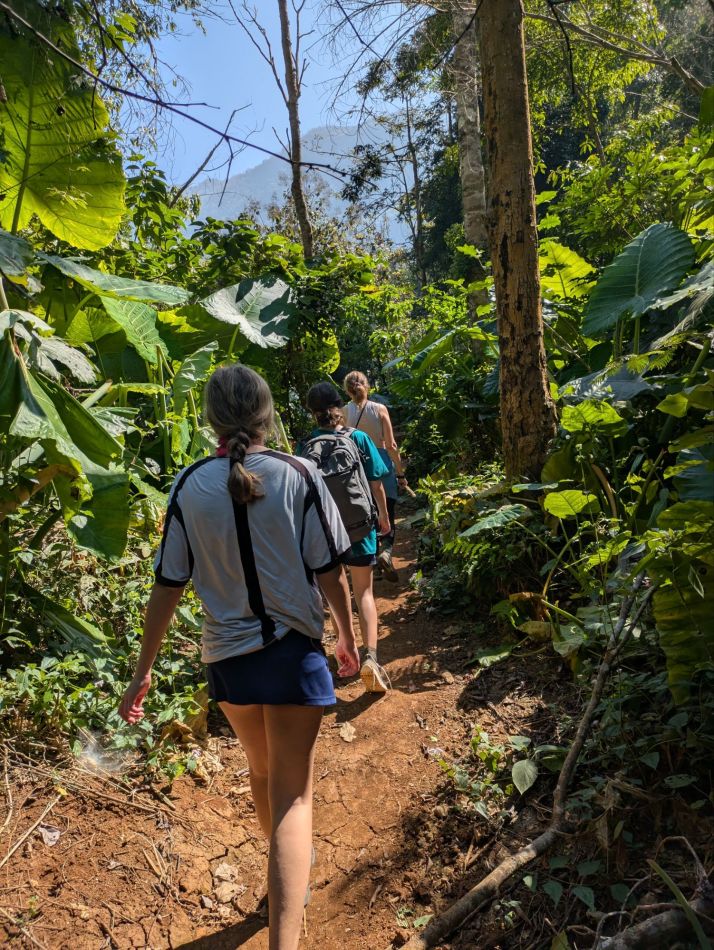
Lucy is half-way up a dried-up stream in the hills outside Luang Prabang. The gradient is 45 degrees, like a staircase, the trees crowd us on both sides and overhead the branches dictate that we must stoop while walking.
She has paused for breath and if she is not careful she will topple backwards. Which would be awkward for her and painful for me, given I’m just behind.
We’ve been walking for 5 hours in dry but striking heat on difficult terrain through an idyllic forest, up and down steep slopes. I am fairly fit and I love hiking and I’m knackered.
This is a bloody difficult trek, especially if you haven’t done any trekking for several years. Ankles, calves, quadriceps – they all ache, resentful at the lack of warning.
I try to remember what the travel agent said. I think the adjective in the email was ‘technical’. Is this going to make Luce feel any better?
My mouth moves before my brain.
‘Er, I think she said it was ‘technical’.’
Intake of breath.
‘What the freaking hell does ‘technical’ mean?
I could answer that it is an adjective used quite commonly to do with hiking and cycling. It normally means a fair degree of difficulty; that there may be some scrambling up slopes where hands are needed as well as feet; that it means you should avoid the trek if you want an absence of pain, level slopes, easy views and no loss of breath.
Yet I realise that if I convey that I understood the difficulty of this trek, I am toast.
Hence I choose the most diplomatic answer I know.
‘No idea darling, but [and there is no way for me to say this without sounding both patronising and irritating]… you’re doing really well.’
‘Oh f*** off’
Not for the first time I wonder if I’ve pushed us too far
The trek is a 1.5 day guided hike in the hills outside Luang Prabang, organised through the company Tiger Trails. The plan is to drive 30 minutes, then walk for 13 km up hill and down dale; stay in one of the hill villages; then do 7km the next morning before a celebratory visit and swim in a waterfall.
It sounds goddam wonderful.
We didn’t do any training as we’re not natural hikers, it’s been winter at home and the holiday has hit us with speed – all of us working or at school right up to 48 hours before we went.
No problem I figure – how hard can 13km be? That’s 8 miles which is the distance from our house to the middle of Oxford, done four times. That’s fine?
A minibus and our amazing guide Pout pick us up and the town’s suburbs run out quickly. The rubbish-free groomed centre gives way to the economy beyond tourism: rows of hardware shops, clothing shops, empty building sites, tractor dealerships and Lao version of corner shops. This in turn give way to glamorous large buildings with triumphant pitched rooves, gleaming in the sun. Are these the most expensive houses in the town?
‘No, it’s the police station and office’ Pout replies.
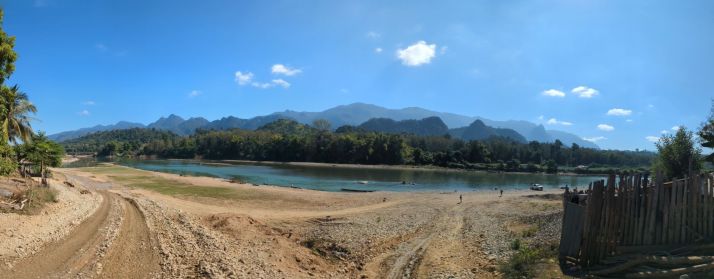
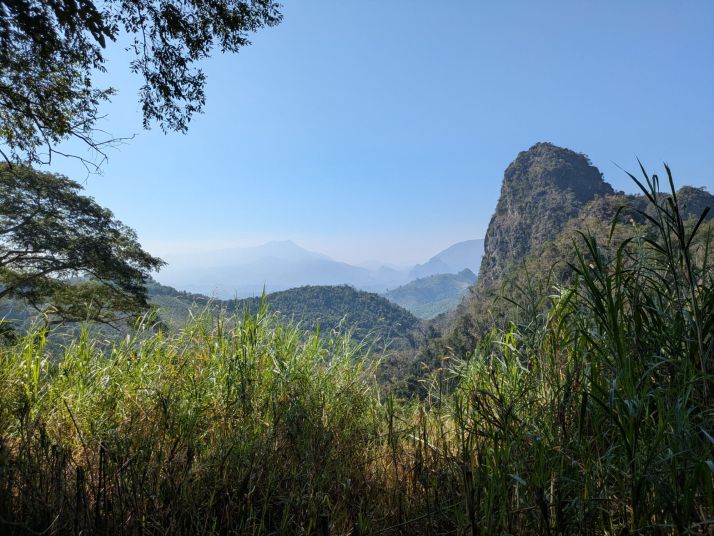
The trek is beautiful from the start. Standing on the river’s natural shingle beach, we cannot quite sum it up. A procession of green peaks and hills runs from left to right, behind the river, as if a set designer wanted to boost us up with a view to last a lifetime.
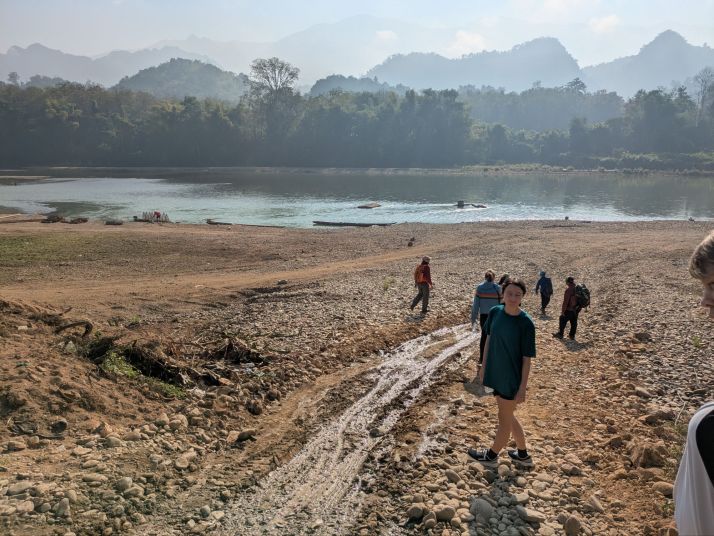
We cross the Nam Khan river by long-but-fast boat (this is the large tributary that merges with the Mekong in Luang Prabang) although the boat driver’s dog is left on the shore and he/she looks distressed (the dog that is; the driver has an inscrutable cigarette in one hand an the tiller in the other). We disembark with little elegance, and, like that, we’re trekking.
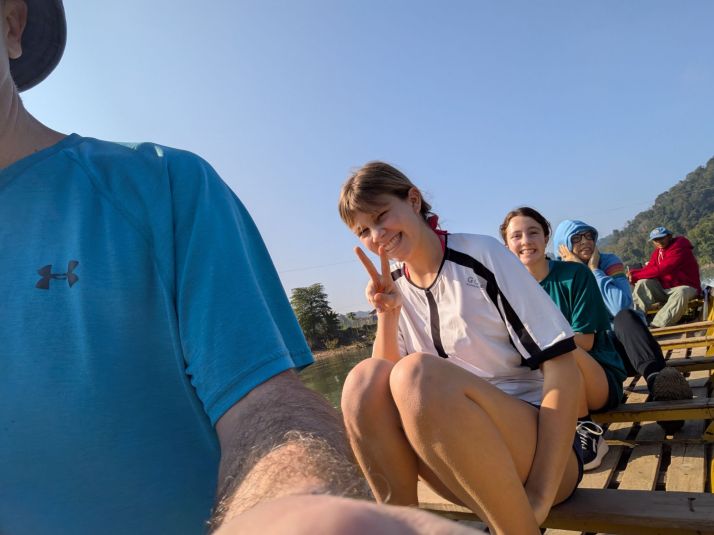
Uphill.
Get used to it.
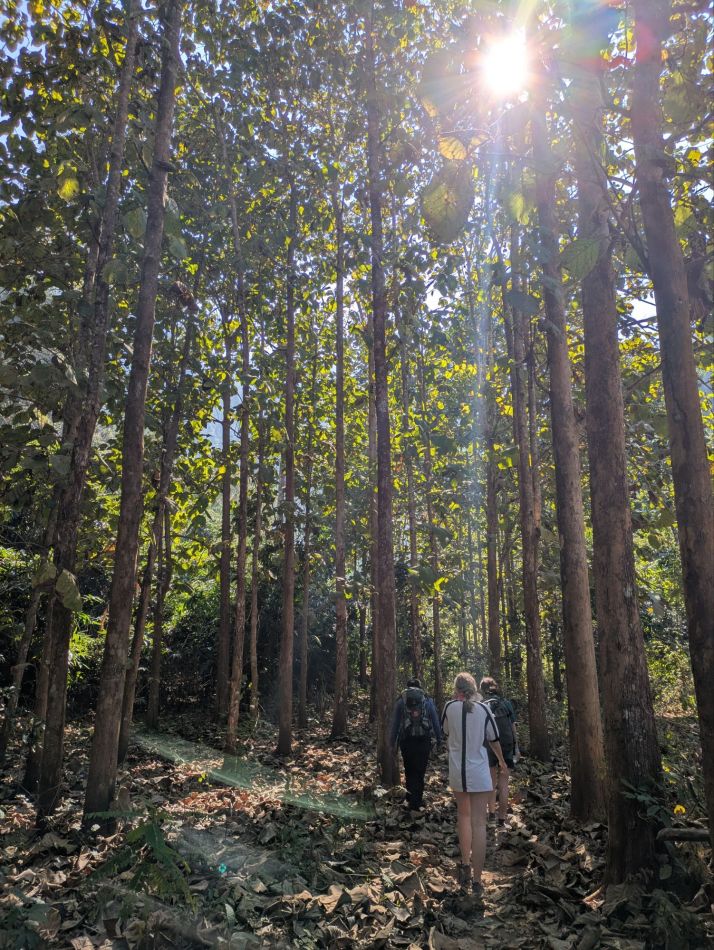
It’s 9:30am and perfect. Th sun is out but under control and slicing through the trees; the shade is built to walk in, there is zero sign of humankind and it is just endless teak trees growing a reasonable distance from each other, one guide, four almost-sweating Brits and a thousand billion uber-large teak leaves covering the forest floor. Pout says this is teak but not the famous hardwood kind – the wood is too weak to become the upright pillars of houses; instead it is used for ceiling timbers and windows.
Heaven.
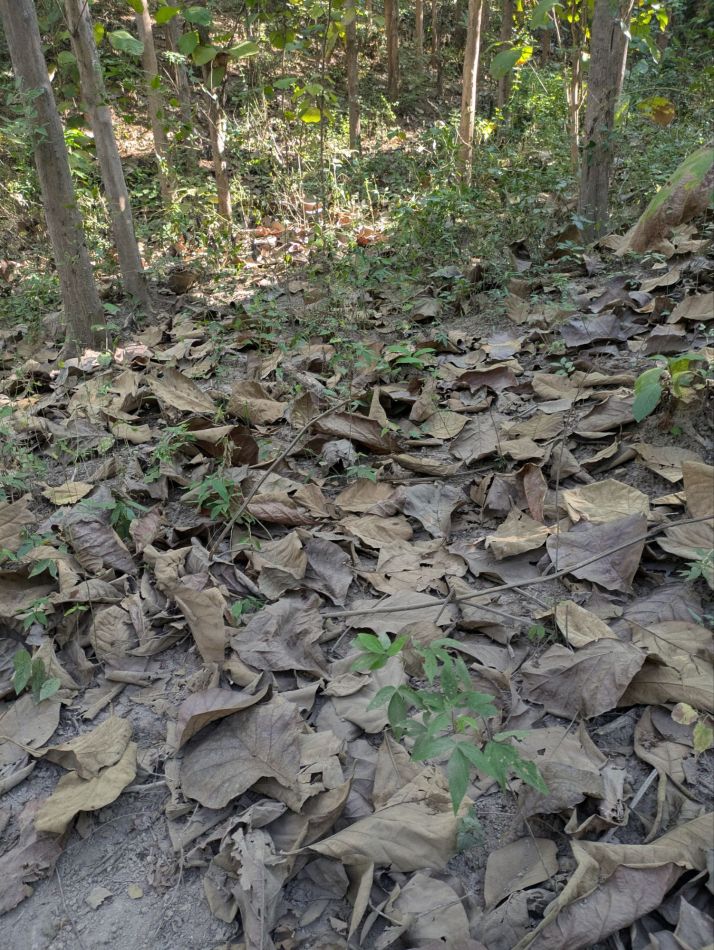
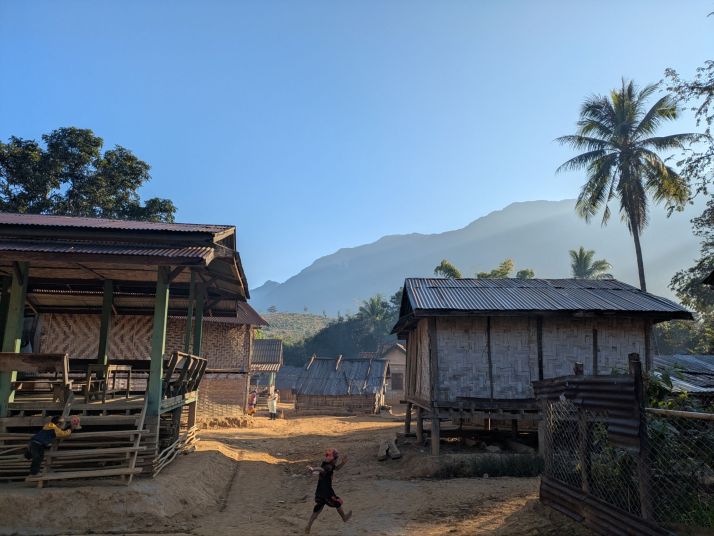
We make the first village and Pout jokes that we visit their ‘7-11’ shop. We buy coke and sweets and refrain from asking how far we’ve gone. We all know that we’ve only written the Introduction to today’s essay and it is better to focus on the present, not the future.
The village is empty. Pout says the men go into the forest to hunt during the day. The harvest finished a month or two ago and because of the plentiful rain it has been a good year. They go off to hunt for bamboo rat, deer, snake – anything they can find. Sometimes for days, mostly just for the day.
The children go to Primary and Secondary School in the village then are sent to the city (Luang Prabang) for high school. They either stay in dormitories or with relatives as it is too difficult to commute each day. If they can they go onto university then Pout says they are unlikely to ever return to live in their home village as they can earn more money by going abroad to do manual work in Thailand. They send money back to their parents and grandparents, but once you get used to earning money and the horizons have been opened, you’re unlikely to opt for subsistence farming even if you’re in paradise, the growing conditions are superb and the family ties support you every single day.
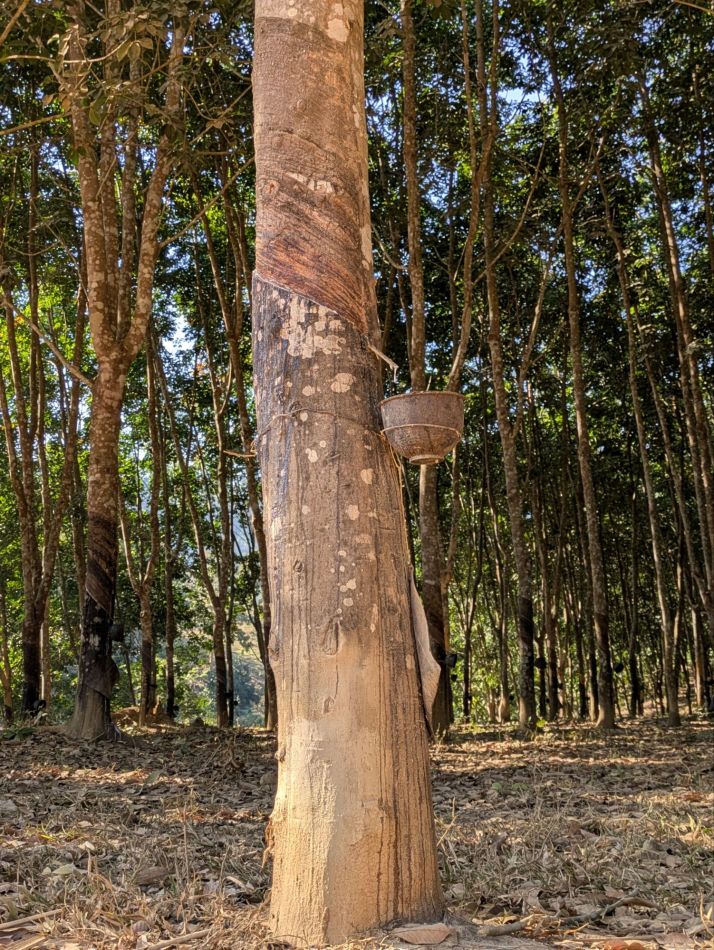
Cloistered paths give way to valleys which turn into shaded trails. The scenery changes every 20 minutes and Pout peppers in with ongoing education. We pass rubber trees which are still being tapped – I think he said the locals get $1 per 1kg of sap. We pass banana and pineapple fields, carefully tended and planted. We pass rice fields lying dry and empty at this time of year. We pass massive leaves they call elephant ears. We pass random solar panels which show that development has some impact – nobody wants to live without electricity.
We pass through a second village, or maybe it was a hamlet given it had 3 homes. It seemed desolate and unliveable but how are we to judge? One man emerges to wash in the lake. We sit and have our picnic lunch surrounded by his animals: three of the thinnest dogs and ten of the skinniest chickens you can imagine. Their hunger hits us and turns the lunch into guilt as they drool over the smell of pad thai. Four black pigs want some leftovers but the dogs snarl them into submission. The dogs pose little danger to us – if we raise our walking sticks they cower into their own weak submission – beatings with sticks are clearly the tool used to create canine obedience in this part of the world.
We pass some heavy industry – granite farming, or, more accurately, granite mining. The technique is old school: they dynamite the cliff face, then through brute force turn large rocks into smaller rocks and smaller rocks into small rocks then small rocks into pebbles.

The granite pebbles are the foundation – literally – of progress given they’re used to build roads and in the construction of houses, often mixed with cement. The whole production line has 4 men working on it and I doubt that the local Health & Safety team coming knocking too often.
We have some technical problems. Technical beyond the hiking description. Luce’s shoes give up and Pout kindly donates his flip-flops to her for the last hour of the hike.
You have time to think on a hike and the thoughts are obvious – this is pure luxury. Not so much the views and the flora and the sense of exquisite joy at seeing somewhere new, but the total absence of other tourists. In six hours walking we see nobody. Fortunate, privileged, lucky – take your pick of words, some loaded, some not, but we all know this is a special experience to be savoured. This sense of fortune goes beyond the tourist angle – we talk about the life they locals lead. They may be happy, they may not – I have no idea and I cannot judge on a couple of days here. However, we have the choice to visit and the choice to leave and my understanding is that most of them do not. This is is the ultimate luck.
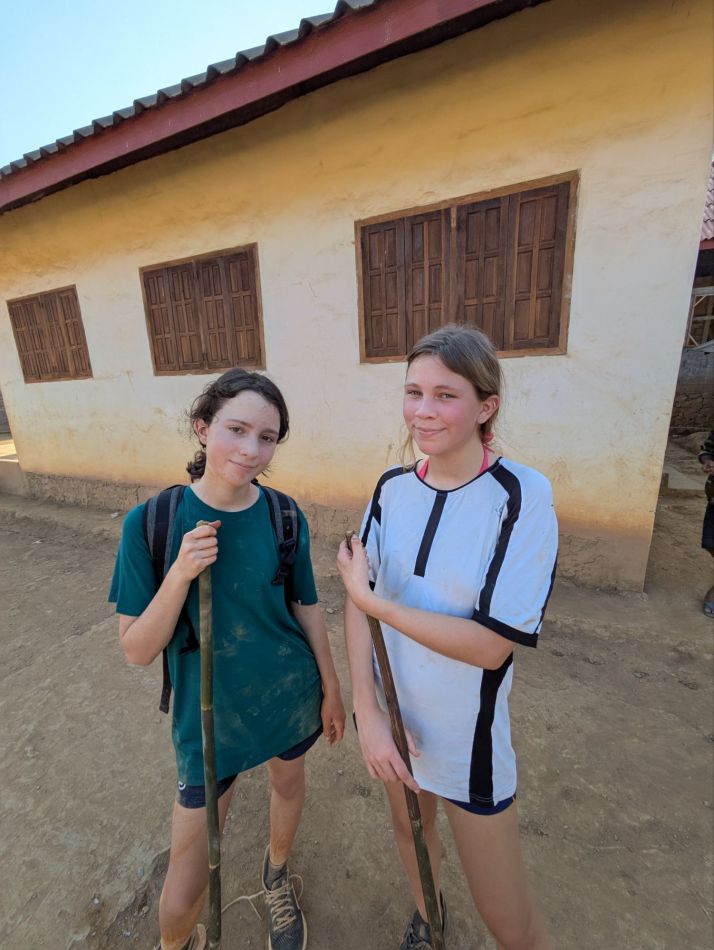
We arrive at our destination exhilarated but in such a tired way that we couldn’t speak. The girls were far stronger than their parents and didn’t complain once – perhaps we’ve got something right about this parenting lark in the last 16 years.
The most spectacular part of this mini-adventure was not in the brochure and you won’t find it on any Insta posts or local postcards. And you can’t photograph it unless you’re a camera geek expert in long exposures and tripods – for a brief moment I wish I was.
It hits us as we head to brush our teeth while going to bed at 7pm: the stars.
The stars, the stars, the stars.
They overwhelm with their clarity – there is almost zero light pollution within a radius of 12 km and the stars seem brighter than is possible – that set designer playing with our perception again. We easily find Orion’s Belt and the big dipper / saucepan but get confused about the North Star. There seem to be two. And I only had one beer. We pause and try to commit it to memory in silence.
Time for bed, but sadly, not much sleep.
I am not going to claim that we enjoyed staying in bamboo huts, each room 5 foot wide and 10 foot long. The mattress was fine; the problem was the walls made of tissue paper when there were 8 other tourists snoring like drunk pigs within two foot of your head. The situation is very democratic – when one person needs a pee in the middle of the night, everyone wakes up as the whole structure creaks and groans with each step. Indeed, the act of peeing reminds you of your life of luxury back home – here there is a pitch black toilet block and if you don’t take your phone you will most likely pee on your feet.
Still, it was only one night and at breakfast we inhale the first rays of sun and Nescafe’s 2-in-1 coffee (milk power mixed with coffee – it only took mankind 2000 years to come up with this) transforms exhaustion into expectation.
Luce teams up with a very kind Japanese family for a shorter trek to the waterfalls – this time in my sandals. The girls and I head off with Pout for a much easier 7km trek – easy sandy paths through the palm trees, very few hills, golden 20 degree sunshine and only the locals commuting on their Honda motor-scooters down the middle of the earth and rock road.
The waterfalls are incredible – clean and litter-free with remnants of past tourist infrastructure hinting at a previous boom: tree houses, jetties, stairs. We change just out of sight and jump in.
Heaven.

The last word must go to Pout – our guide from Tiger Trails. At all times he was cheerful, patient, funny, wise and helpful. If you ever go to Laos I strongly recommend him as a guide.
 Travels with my Family
amazing pictures. Well done all that hot sun hard trekking. Great to do it while you can. Next time better shoes ? Maxxx
LikeLike