
Vietnam is an economic success story, but one that you don’t hear much about. It’s GDP averages 6+% since 2000.
Or perhaps you do if you look closely at your Nike shoe or clothing labels. Apparently, the Portland sports giant has 13 factories in the country and up to 200 local firms on its supplier list. The Government website claims that half of Nike’s products are now made in Vietnam.
With a combination of high skills, relatively low labour costs, a focus on FDI (getting foreign investment into the country) and a growing reputation for being slightly more reliable than other Asian countries, perhaps it is inevitable that the entrepreneurial Vietnamese is processing and packing one very lucrative segment:
The tourist.
We are in Halong Bay, two hours by luxury minibus from Hanoi, the capital of Vietnam in the northern corner of the country. It is known for poor weather relative to the rest of the country, but it also has one of the world’s great visual wonders just offshore.
We are here to see one thing and one thing only: limestone.
That’s right, 2 million tourists arrive each year to see the cascading karsts – the small limestone hills which stick out of the water by only a few hundred feet. There are up to 2000 of them dropped into the sea like confetti outside a church, and they are gorgeous; so gorgeous that non-geographers and non-geologists enjoy them just as much as the supposed experts.
The have been formed over 300 million years and these days they are a natural asset which create serious profits. And where there is strong demand you need an assembly line, strict processes and a commitment to quality control.
Just like in any factory.
In fact, the tourist is happy to be processed and happy to be here. For many of us this is a long-planned and long-held treat. We try to keep expectations low but we cannot forget the many compelling photos of karsts retreating into the sea, all different shades, with nobody in sight.
We wait in the port terminal which is chaos. Hundreds, if not thousands, of tourists are coming and going, their guides and tour leaders shouting at their group trying not to lose them. Imagine Central Station in a Meg Ryan movie, only with less make-up and worse lighting.
We sit tight. We have met our tour leader – self-styled as ‘Windy’ as she has found that we ignorant foreigners cannot pronounce her actual name – and Windy has the elbows to cut through the crowd and a voice which commands respect.
Eventually we are pushed and pulled into a line, ordered down the dock and shoved into a tender. We look around – who are these people? With 26 on each boat, we have 22 new friends but the vibe is not chatting. Half seem to be Italian. Or is it Spanish?
The boat is a triple-layered blast from the Agatha Christie past, cabins and showers and external corridors for the murderer to sprint along. We are overwhelmed with food as the tour company long ago realised one truth: tourists complain when hungry. Kill them with kindness or with locally grown oysters and beef, whichever comes easier.

The day is not arduous. We change and go kayaking, a treat in the pre-golden hour light, heading for a beach. We swim, we come back, we are ordered upstairs for a cooking demonstration before dinner but the high wind disperses the crowd.

The staff work like Trojans, feeding us like a baby: every 3 hours. There are 7 other similar boats in sight; these seems like a lot until Windy tells us that we are lucky to be here (in Bai Tu Bay – which is near Halong Bay but not the actual bay – something we didn’t realise) as in Halong Bay you have 2000 bed mega ships which churn up the sea and damage the environment.
The anchor stays in place and we all sleep better than you might think.
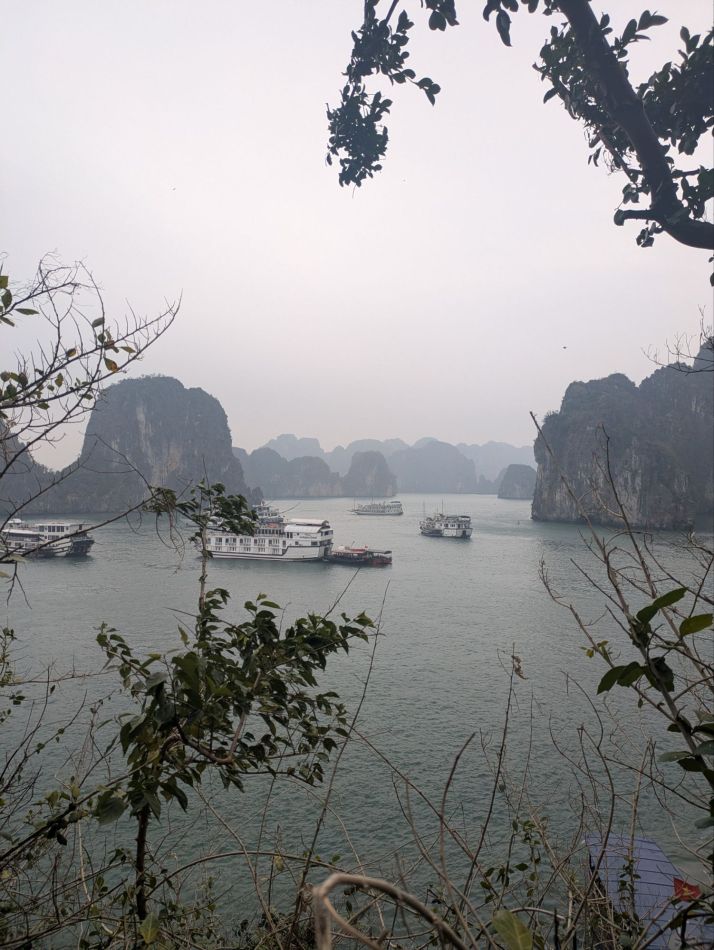
The next morning the factory rouses into shape and by 7:30am we’re on the tender to look a large cave. There were no murders in the night; the ghost of Agatha Christie lies undistrbed.
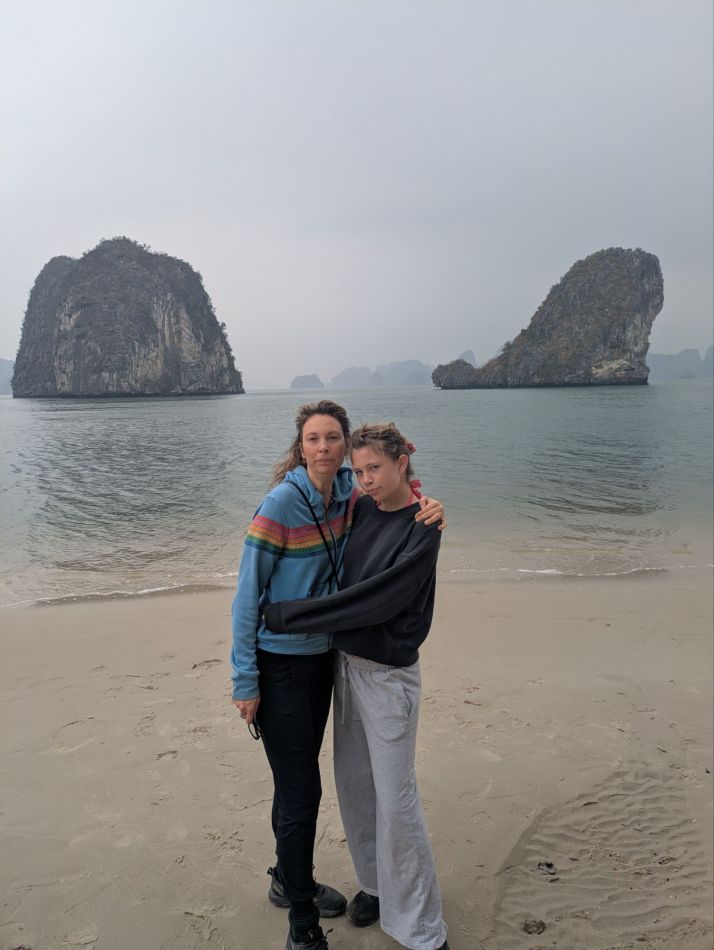
Limestone creates caves when rainwater dissolves rock over millions of years. There are four other boats trying to do the same thing and all the tourists say relaxed – only half have had their coffee and we are all grateful to be here even if it overcast.
I lie on the top deck during the next cooking demonstration. A large lunch appears at 10:45am as if the cook feels guilty for starving us.
26 people, 22 hours, 1 very effective tour guide.
Of course there is a human cost. It seems the crew work long hours and 5 days off a month is the norm. If that leaves 25 days work then that is 12 rounds of tourists like us. That’s a lot of prawns and fried squid. I can’t see 5 days off a month going down well with the private or public sector in the UK.
After tipping the crew and our guide, we’re dragged onto land and handed to our taxi driver. I told you this wasn’t a hardship. We have been fed, watered and given our karst experience and it is time for the next batch in 60 minutes.
We look around the port and see extraordinary tall, ugly hotels and large apartment buildings: how can the local economy justify the creation of so many large buildings? I am baffled. I see 150 large green dumper trucks in two lines all parked up with nowhere to go and I regret the speed with which we’re moving through this part of Vietnam – too many unanswered questions.
We are grateful for Windy’s friendly efficiency and impressed by the tourist industry: if they want 2 million people a year to experience the karsts then they need to be processed, packed and sent on their way.
 Travels with my Family