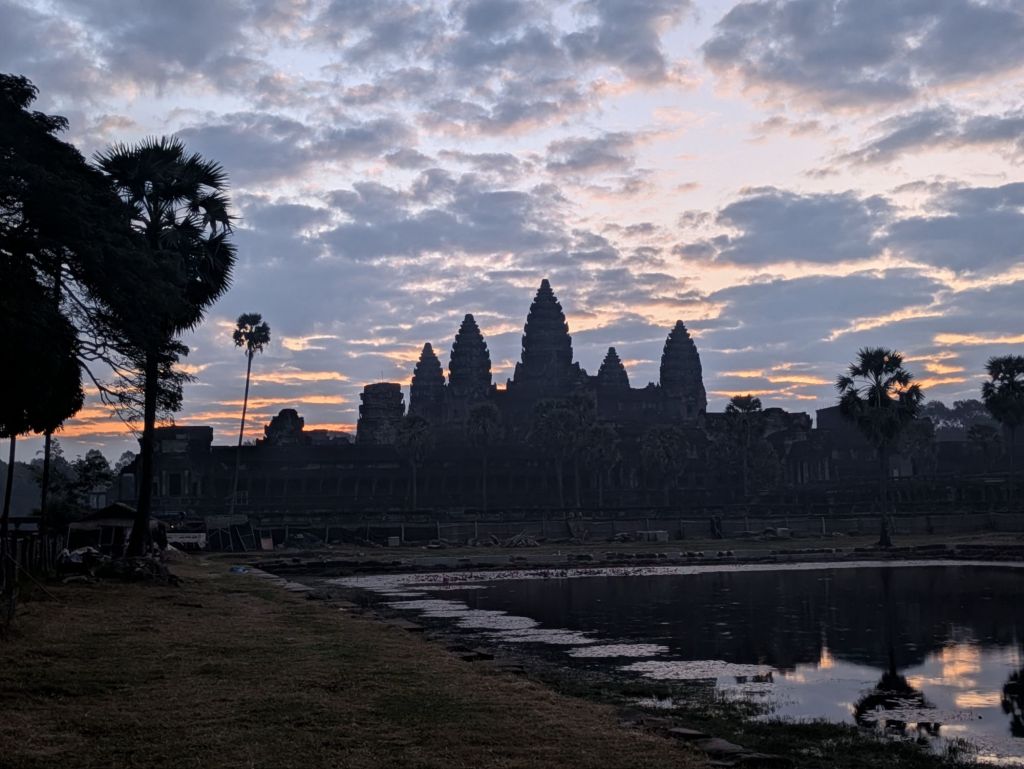
‘Why did we get up so ****** early – we told you that 5am was too early.’
Mutiny is in the air.
The aggressive wake-up time has disturbed the troops.
‘If you knew the sun rises at 06:27 why the hell did we get to Angkor Wat at 05:25, a FULL HOUR BEFORE WE NEEDED TO?’
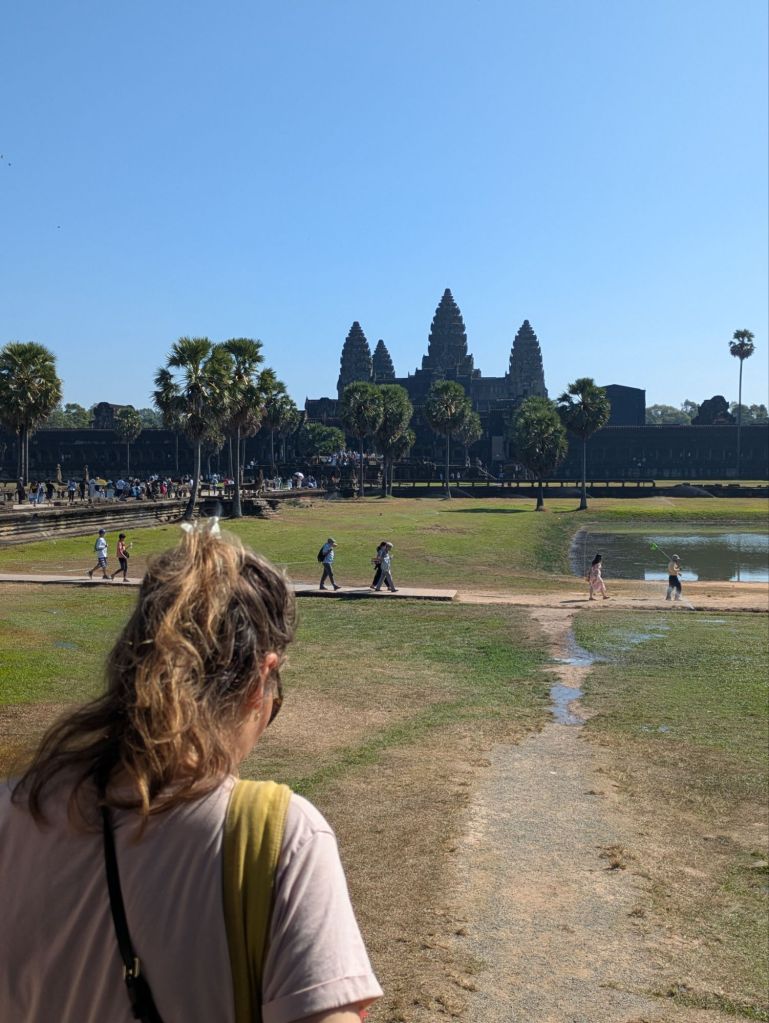
We are attempting to see the sun rise over Angkor Wat, one of the great wonders of the world. Or should that be Great Wonders of the World? When I write ‘attempting’, the point being that if it is cloudy then we won’t see the sun rise – we’ll just see it get progressively lighter.
I become defensive – again. And think it through…
They haven’t factored in the 2000 people jostling for position, all after the best photo to validate their social media.
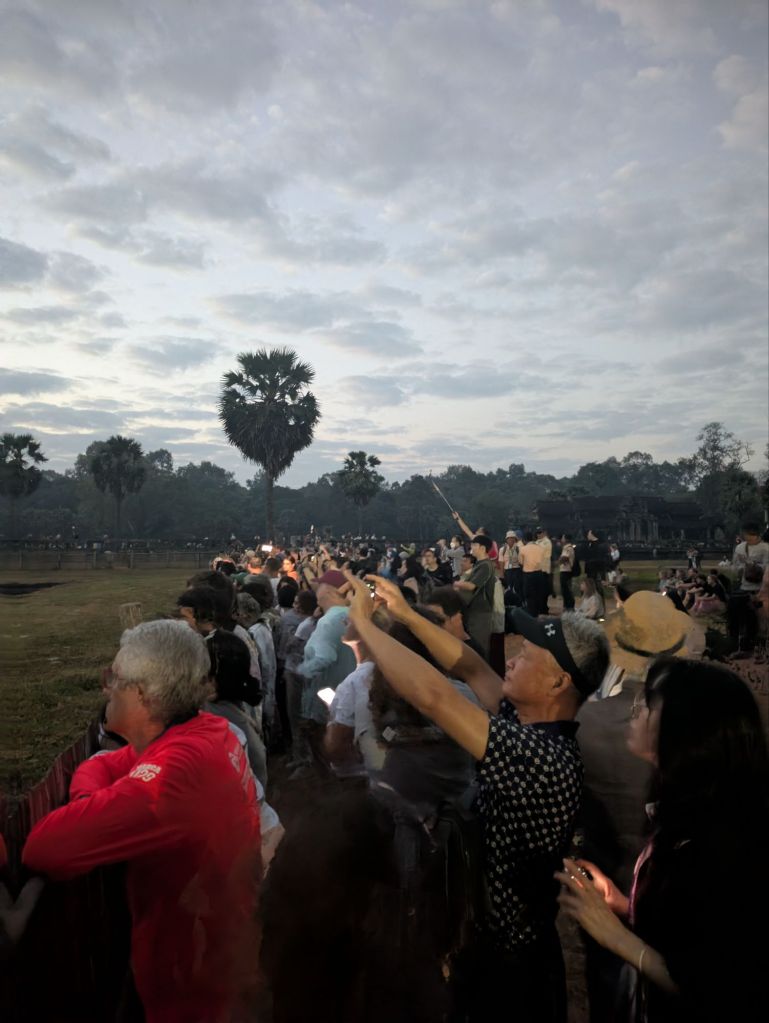
They haven’t factored in the 15 minute walk from drop-off to the Angkor Wat main temple.
They haven’t factored in that twilight starts over an hour before sunrise and by 06:00 it will be – effectively – light.
But they have a point.
We could have left 20 minutes later. They could have had 20 minutes more sleep.
It is not life or death, just a little sleep-starved tiff that punctuates the morning’s adventure.
We sit at a stall to the side of the lawns outside the main temple and drink green tea (Lola, Dan), hot chocolate (Cesca) and coffee (Luce).
It is getting lighter and the eastern part of the sky most definitely has clouds. Hmm.
In a flash, the 4:45am alarm call proves its worth. Sneaky shades of red and orange cut through the gaps in the clouds and the quiet majesty of Angkor Wat’s main temple cuts the most elegant silhouette.
The massed punters all raise phones and the communal joy is tangible, albeit muted. Too early for whoops and any upset at the lack of burning orange sun is softened by the unambiguous fact that this is special, beautiful, and to be committed to memory for permanent possession.
Mutiny subsides, although they’re not going to let me off lightly.
‘Aren’t you glad we made it?’
‘I told you we could have left later.’
Angkor Wat is the most famous tourist attraction in South-East Asia and arguably the equal-most-famous with the Taj Mahal. It is a large collection of temples spread out through the jungle outside the city of Siem Reap. Built in the 12th Century over 37 years, the king wanted something magnificent to worship the Hindu gods. His relatives added in statues of the Buddha later in the century and it takes us half of our guided tour to understand that Angkor Wat serves two religions.
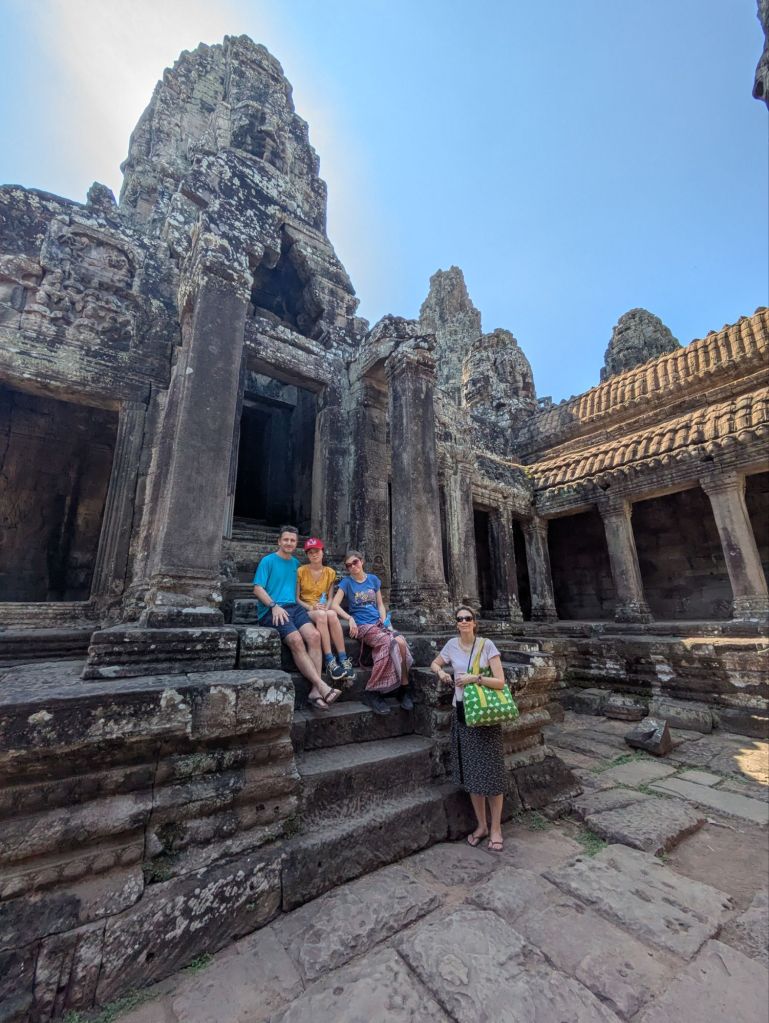
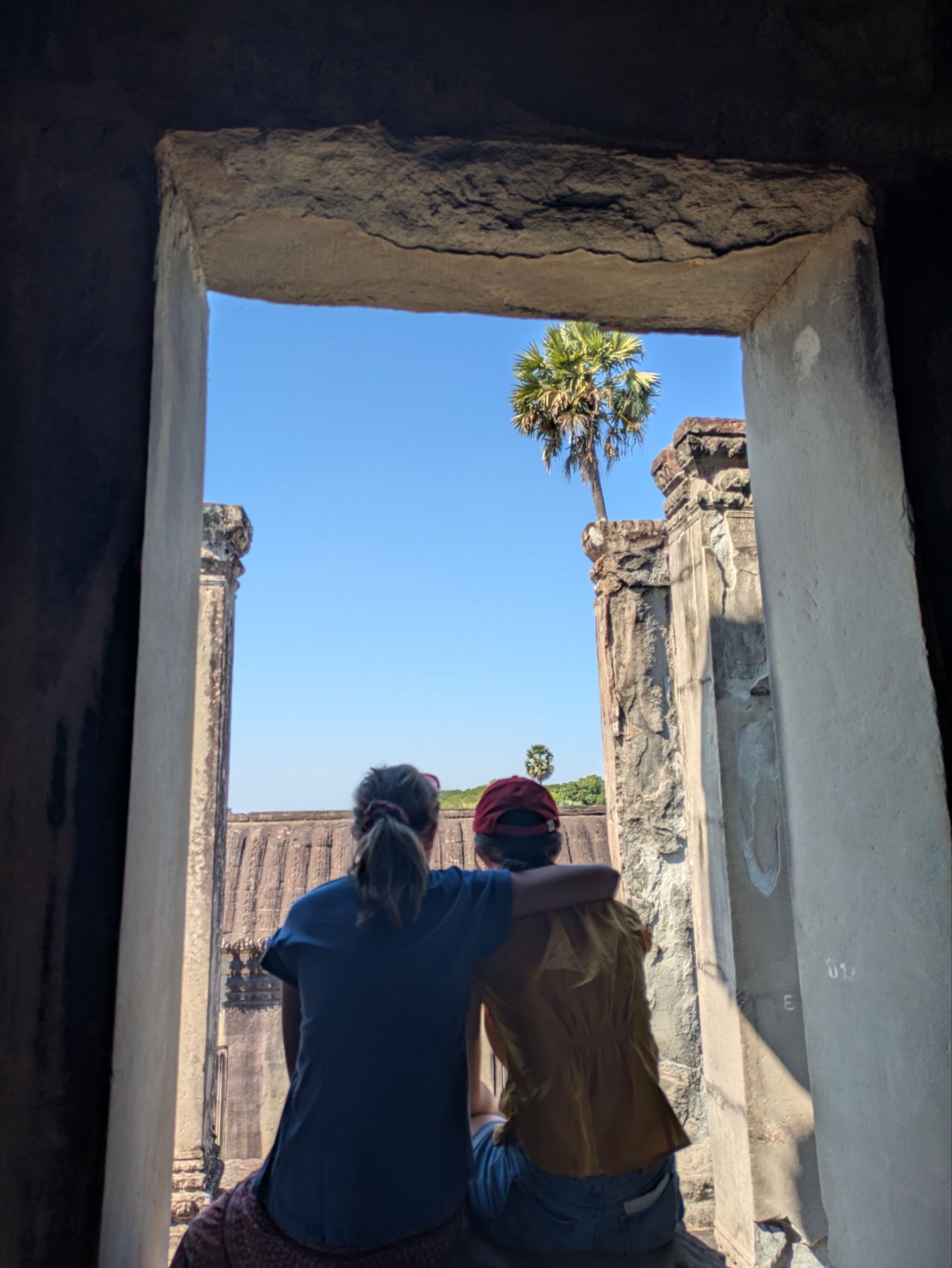
Mega-famous buildings can be a let down, but the scale, the detail, the beauty, the spirituality, the sheer back-breaking agony of the construction process means that Angkor Wat cannot disappoint. Much of the stone was rolled to the location from 70 km away (the stone didn’t roll – it was set on bamboo timbers which did the rolling). Trying to do it justice via a little blog post is impossible; like the charisma of some politicians and film stars, Angkor Wat needs to be experienced to be appreciated.
Is it one of the Seven or Eight Wonders of the World? It depends on who you ask. It turns out there is no definitive list of Wonders and these lists are rarely neutral and seem to be re-written by organisations with an agenda.
If we’ve seen it, it is going on the list.
The temples have a cinematic quality, and indeed the third of our three temples is known as the ‘Tomb Raider temple’. It features in the Angelina Jolie film ‘Lara Croft – Tomb Raider’ from 20 years ago. The film is dross (sorry Angelina but the acting is more wooden than the Laos teak forests from several blog posts ago) but the temple is overwhelming – tree roots have conquered rocks and we have rarely seen nature merge with man’s best work like this.
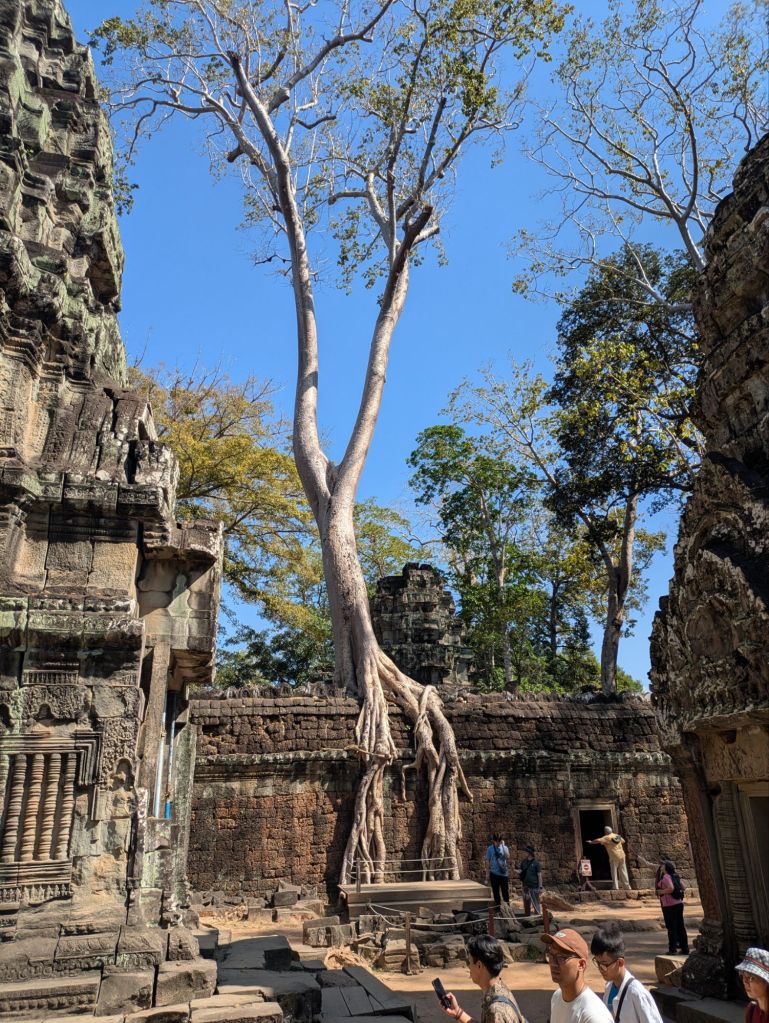
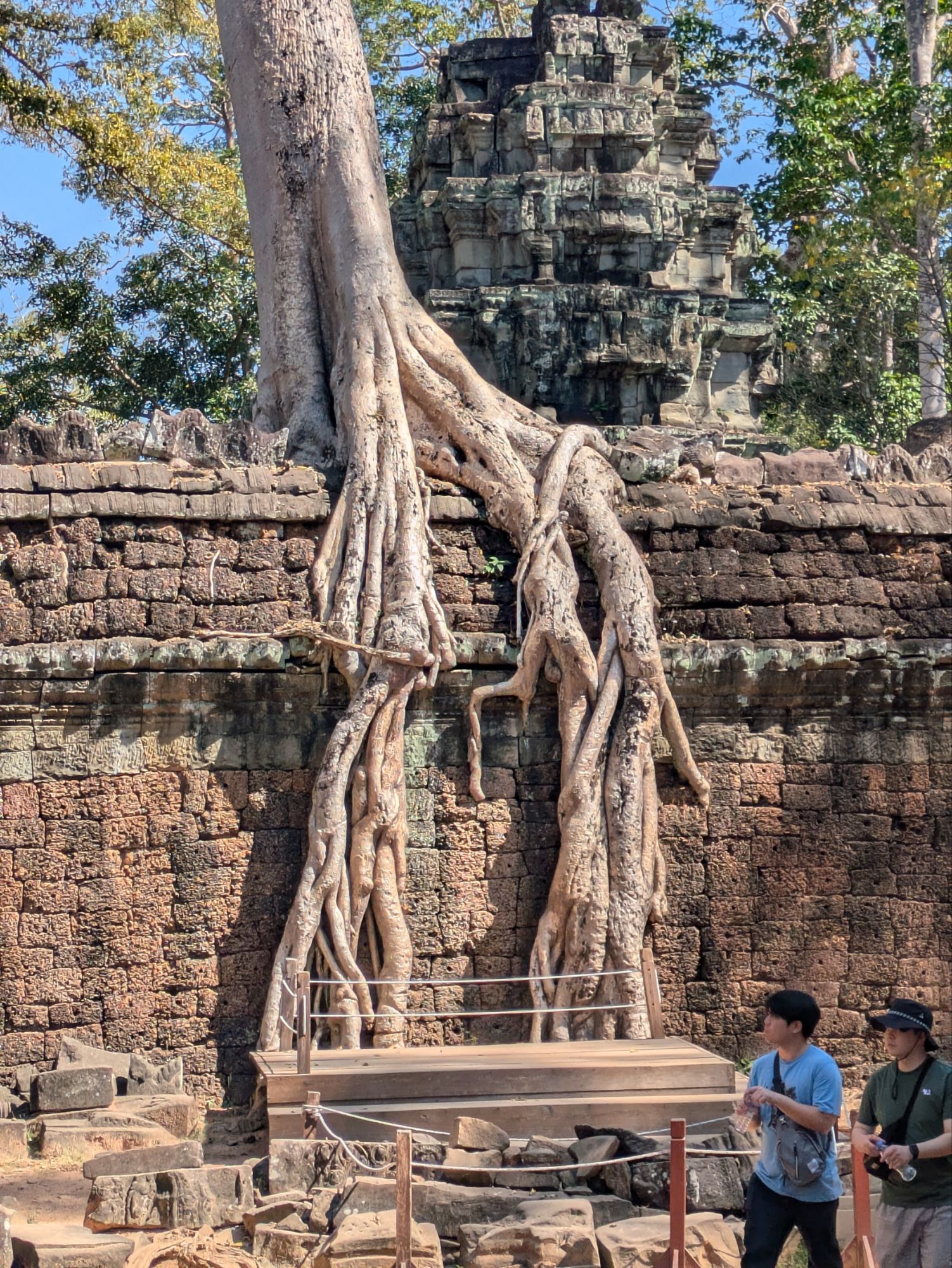
Parts of the temples have fallen down over the past 900 years. India contributed to a major renovation project in the 1980s and 1990s and our guide tells us that Unesco funds are needed for further repairs and improvement. The site attracts over 2.5 million people a year which at $37 makes $92 million a year. When we ask our guide why the Government cannot pay for repairs, he goes quiet – free speech may not yet be part of the culture here.
Or perhaps the Government needs to take the funds from Angkor Wat and invest them elsewhere in the country? Repairing ancient blocks of sandstone for an audience who will visit anyway may not be a priority. The IMF says the total size of the Cambodian economy is $47 billion, roughly 20% of what we spend on the NHS in the UK (£192 billion in 2024).
In a country intent on climbing its way into prosperity, Angkor Wat is a towering cultural and economic asset.
Our guide also references the genocide which the country went through in the 1970s, and we feel ignorant that we do not know more about it. Indeed, the sun is so warm, the people are so friendly, and the jungle is so compelling that the country’s decades of murder and horrendous international politics are nowhere to be seen.
Much more on this in my next installment.
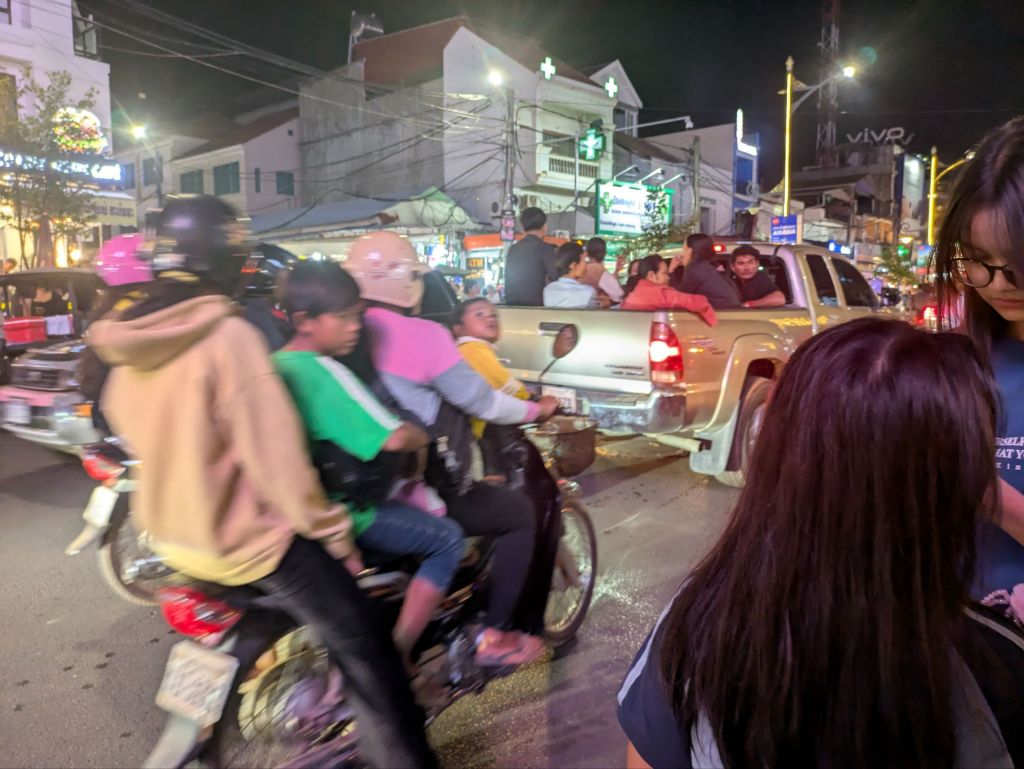
The closest we come to violence is trying to find dinner and witnessing Pub Street, the name (honesty, I have not made this up) of the tourist epicentre in Siem Reap. It is like we have slipped through a vortex into a concept street which Magaluf declined for being too objectionable. It is a street of 20 bars, all clad in neon and playing music to out-do each other; the result being that every bar is turned up to 11 and hence nobody’s music can be heard. Meanwhile tourists (both western and Asian) sit under the speakers and eat their wordless dinners as nobody can hear each other to talk. Perfect for people sick of their travelling companions then. If you think I’m being grumpy and old, ask Lola or Cesca for their opinion.
We cannot cope with Pub Street on any night and certainly not on New Year’s Eve. To some dismay from les enfants we slip away to bed at 10pm. Boring but wonderful.
 Travels with my Family
Special picture of you all under the enormous ancient building…one to print and frame.
Ma xxx
LikeLike