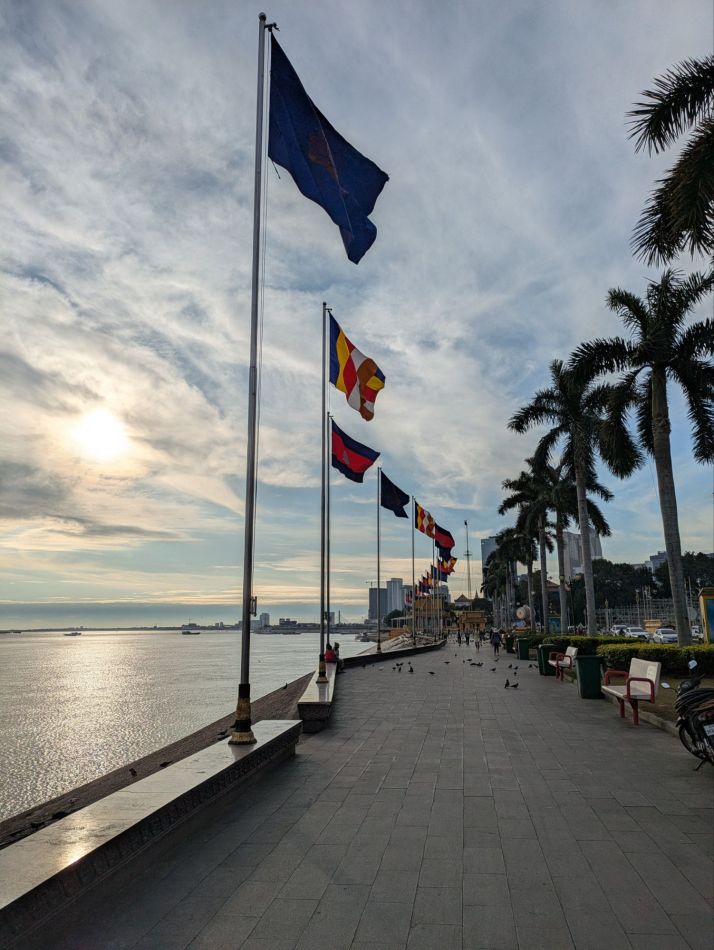
Two questions bother me after five days in Cambodia:
- How can a country recovering from genocide be the friendliest place on earth?
- Why did the Americans support Pol Pot in the 1980s after he’d overseen the murder of 2 million Cambodians?
====
People travel for fun, for good times, and you could sail through Cambodia and emerge still ignorant about the genocide in the 1980s, Pol Pot, the Khmer Rouge and so on.
It would be difficult, but you could do it.
Of course, the Cambodians take some of the initiative to educate. We buy tickets to the circus in Siem Reap. The audience of 300 are all tourists, the auditorium is in-the-round, a bit like Gifford’s Circus, and the organisers put on food and drink stalls beforehand to capture more of the tourist wallet. Good for us, good for them.

A circus normally means gags and tricks, clowns and stunts, yet this is this personal story of one of the circus directors. It starts with poverty and flows to the live drawing of the American bombing in the 1970s. There is plenty of tricky gymnastics (physical, not mental) thrown in, but this circus is really theatre; it’s a play to communicate the descent intro trauma that the country went through and how it emerged into sunshine – or is emerging.
I can’t tell you what the many 5- and 6-year-olds in the audience thought of it but the skill, sincerity and energy blew us away.
====
The friendliness doesn’t hit you when you arrive in Cambodia, it hugs you. Apart from the grumpy chap at immigration (aren’t all customs, visa and immigration officers in a foul mood 24/7, whatever the country?), every person we meet for five days is respectful, polite, calm and friendly. We find it simultaneously addictive and unnerving – what do they know that we don’t?
We are on holiday and only meeting people who interact with tourists, so perhaps the friendliness is just good for business – more tips, more repeat business, and so on. But it feels deeper than that. For example, when we try some (mild) negotiating with our tuk-tuk driver, he just laughs. We reach the most accommodating compromise within 1 minute with all of us smiling.

===
Smiling is the last thing on our mind after 24 hours in Phnom Penh. We have just spent the morning at the Killing Fields and the prison called Section 21. It is horrific.
My amateur understanding of events is this: the old Kampuchea experienced civil war for 9 years up to 1975. During this time, the young, ambitious Pol Pot was radicalised into communism while living in Paris. His ambition exploded after travelling to China in the last 1960s and witnessing the Cultural Revolution in all its apparent glory: the control of the people, the purity of the culture, the return to agrarian ideals, the manifestation of the Marxist doctrine.
As the civil war continued, the Cambodians became increasingly desperate – desperate for food, stability, hope, prosperity. Pol Pot was a master strategist and opportunist. The country’s misery, the incumbent exploitative royal family and the American bombing campaigns created fertile ground for Pot’s charisma and vision. Why did the Americans bomb Cambodia? To target those Vietnamese who had gone into hiding in the Cambodian jungle.
Hence when Pol Pot came to power, he was treated as the conquering hero. Indeed, he even managed to persuade the King to support him. As his black-clad soldiers took the capital in April 1975, the locals tied white cloth to their bicycles and rode around in celebration. They had no idea what was coming. Within days, Pol Pot ordered that every single person must leave the capital city Phnom Penh to work in the fields. If you stayed, you were shot.
He copied Stalin and Hitler’s playbooks. From Stalin he took the purges and started to massacre the middle class, the academics – those who could pose a threat. From Hitler he took the extermination camps, called ‘Killing Fields’ in this case. We visited the most famous one and there are 9000 skulls of victims in the memorial tower. Each skull has been classified by gender, age and likely cause of death. I couldn’t take a close-up picture – it just felt wrong – but on many skulls you see the cracks where they were hit with garden instruments to kill them. Apparently bullets were just too expensive.

Pol Pot and his men killed between 1.5 and 3 million people – different academics land on different numbers. Many were murdered and many starved to death in the fields.
===
Our tour guide around the old Section 21 prison is a 62-year-old woman. The prison is horrific with images of the torture, killing and leg shackles on all day. Incoming prisoners were photographed and documented, just as the Nazis kept impeccable records.

We had not connected the dots with our guide’s age. Half-way through the tour it emerges that she was 13 in 1975 when Pol Pot took over. She walked for 3 months to the northeast of the country. Her father and brother were taken separately as ‘they liked to kill the men first’. She worked 12 hours a day in the field with a handful of rice to eat twice a day. She was separated from her mother until 1980 when the nightmare ended and thankfully she found her mother again.
She is not the only survivor of Pol Pot’s time that we see. At the start of the tour, the guide showed us a large photo of 7 children from incarceration in the 1970s saying that they all survived. To very mixed feelings, it turns out that 3 of them are actually in the museum today. We cannot understand this. We are told that the state will not provide them with pensions so they sell books each day – or rather their family do as the three men are too old to speak and can hardly move. One man is over 90. We buy each of the three books at $10 each and feel desperate for them.
It is a lot to take in and we try to have lunch upon leaving the museum. Some trivial issue about the menu turns our conversation into a ratty argument. It feels shameful to be so petty after learning about such great suffering.
===
Early one morning, I go for a run along the banks of the Tonle Sap and through one of the parks. On one level, Phnom Penh looks like any other big city. Skyscrapers. Digital billboards with ads for ice cream parlours. A defining, famous river (the Tonle Sap river meets the Mekong). Endless tuk-tuks. Expats. Pizza parlours. iPhone adverts. Stray dogs and pampered poodles. Skilful games of volleyball using only the feet. Boring grey office blocks sit next to do temples and monasteries.

Yet, as discussed above, all the people you meet are friendlier than in any other big city. The traffic is busy but it is respectful – not an adjective often used with traffic in large cities.

===
From reading around, the USA support for Pol Pot in the 80s was driven by the Cold War and the need to stop the communists (Vietnam in this case) turning one more country red on the map. Jimmy Carter died last week and he’s seen as a human rights hero, but his Government – apparently – helped to train and arm the Khmer Rouge hiding in the jungle in the 1980s, supported Pol Pot in at the UN, and worked hard to keep stasis in the country. Anything to stop the Soviet-backed Vietnamese taking power.
Even heroes have blind spots. Pol Pot died in the jungle in 1998 and never faced justice. Only when the USSR fell apart did the country progress – the Vietnamese withdrew and a UN-led team took over the country. So recent.
==
We don’t solve the friendliness question and, again, we feel the compromises made by rushing through countries in a few days and failing to get below the surface. That said, how lucky we are to have been here.

 Travels with my Family
Excellent analysis and insight Dan – have much enjoyed all your musings from this trip and so pleased that I subscribed on round one otherwise would not have been served up all of this. Safe travels and hope to see you soon. dx
LikeLike