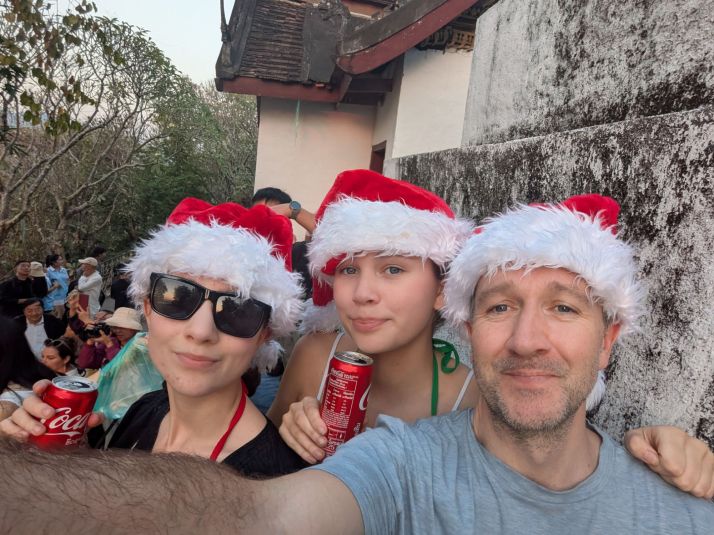
It’s Christmas Day, theoretically, and since Laos has few Christians, the day is not recognised by the Government; only by a few tourist outlets displaying garish red and white decorations with uncharacteristic desperation. The children go to school, adults go to work – this is just another day.
Not in the Channer family though.
We exchange presents in a half-hearted way; only Luce remembered to pre-pack gifts and the emergency shopping trip that L&F and I did yesterday yielded a few trinkets, nothing more. Within 12 hours the green bracelet we gave Luce has dyed half her arm a sweet colour of jade. No wonder it was cheap.
The number one tourist activity in Luang Prabang is to climb Phou Si, a bizarre short sharp hill in the middle of town, to watch the sunset. You are warned there are 329 steps and you wonder how many unfit tourists suffered heart attacks before the warning signs appeared. The myth from the Ramayana is that the hill was stolen from Ceylon (Sri Lanka).
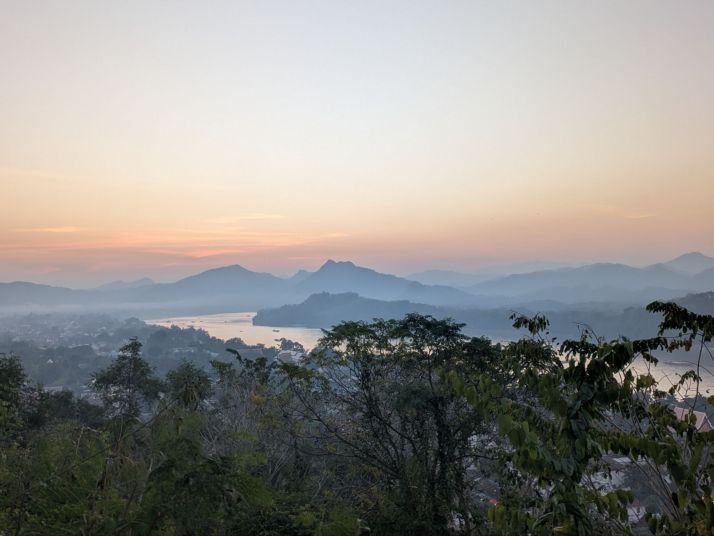
The top is crowded, and that’s okay – this is the number one activity remember and the views are beyond spectacular. The Mekong oozes into the distance, just below the changing orange kaleidoscope, the surrounding hills settle down for the night, the whole town appears calm and controlled as suburbs blend into forests below us from our 360-degree position.
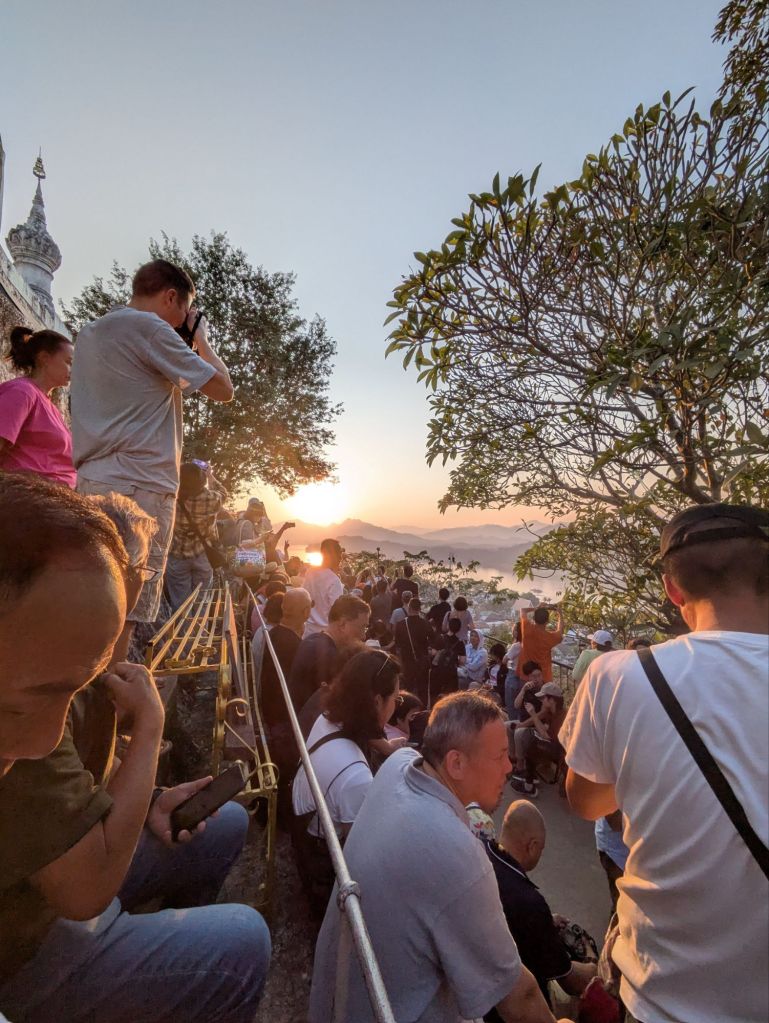
With ten minutes until the sun disappears, people are jostling for position. One (Chinese?) tourist pushes Lola out of the way to get the perfect picture – to the victor the spoils. We sit back, drinking Coke, wearing our silly Santa hats, letting the sugar and caffeine invigorate the legs. As the sun goes below the hills, the crowds thin and we exhale, taking in the views from the rest of the summit.
Happy Christmas indeed.
‘We’re communists but nice communists’
Quotes don’t come much better from one of the locals we get talking to. You feel the Government influence in Laos, but it doesn’t appear to be communist in any way. All the normal purchasing behaviours point to a market-based economy; there appears to be a hierarchy of working and middle classes like there is in most capitalist societies; and nobody seems to be fearful of selling you products and services.
The politics seems quite simple as there is only one party. Yes, just one. Makes elections easy for the indecisive. It is called the Lao People’s Revolutionary Party, and the President is the General Secretary of the LPRP. The President is elected for 5 years and he / she nominates the Prime Minister. You wonder how much ‘revolution’ the Party wants given it has total power and no opposition? Not much I imagine.
When we try to probe into the subject, we are met with a wry smile and a cul-de-sac. Perhaps old habits die hard and public opposition to the ruling party is not acceptable. We flash our own wry smiles and change the subject.
At midday on Christmas Day, we (well, ‘I’ but ‘we sounds more in the spirit of a family holiday) go for a run and encounter Government policy in real-life and a problem that many countries face: the increasingly destructive impact of climate change, the political intervention to fix or mitigate it and the societal demands for compensation, or at least to experience zero loss due to the mitigation.
I’m running along the Nam Khan river, away from the merger with the Mekong and immediately the geo-engineering comes into view.
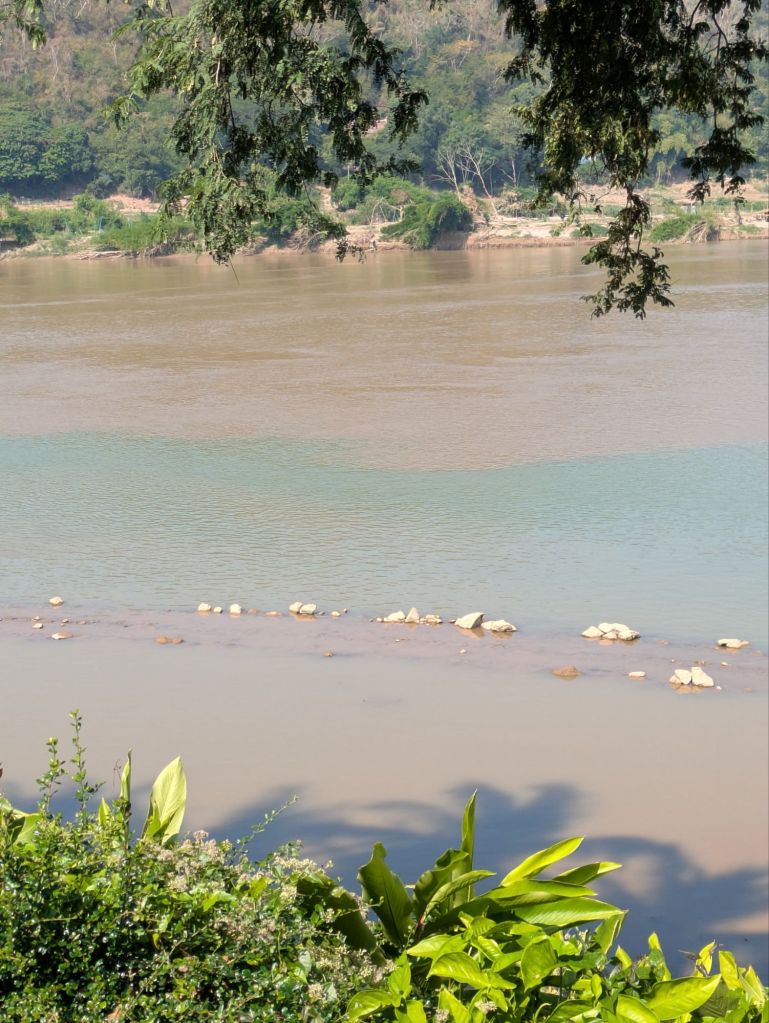
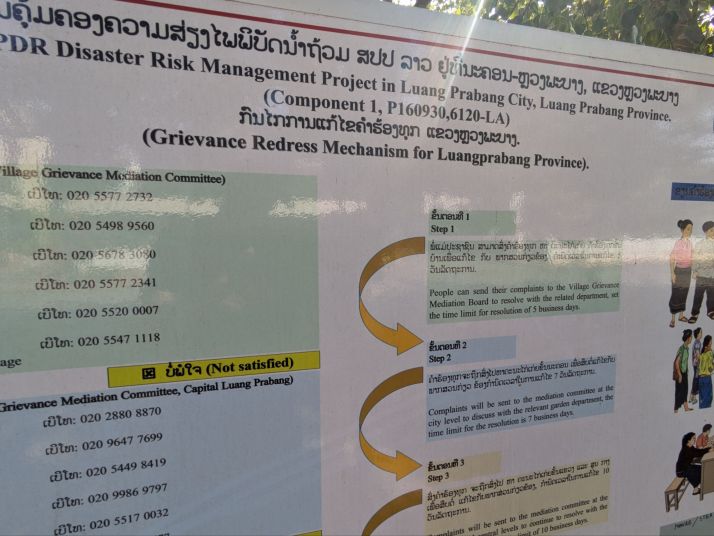
A couple of large machines are shoring up the banks of the river, whether through earth or rock. I see a tourist staring at a noticeboard which explains the works and we get talking.
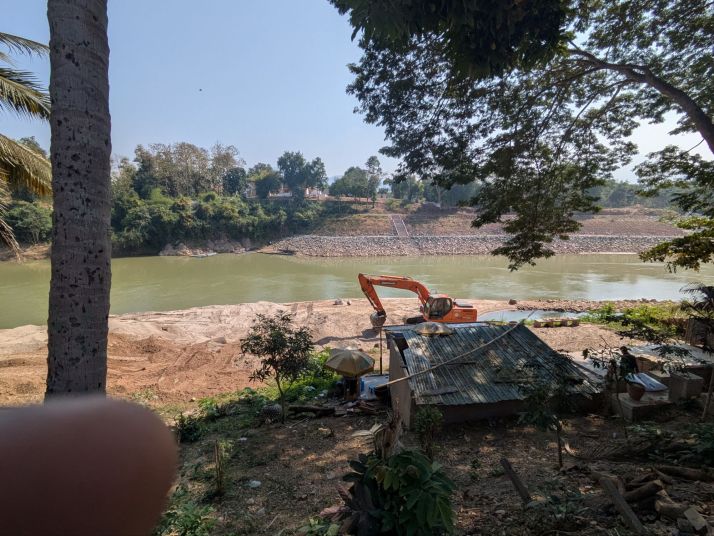
She is German and worked for the World Bank in this region for years. In the rainy season the river gets so high and strong that it washes away riverbanks where people live. The geo-engineering aims to fortify the banks, but she explans that the challenge is social, not geographic:
‘The problem with all these schemes is the people, not the engineering, not the technical. For years it’s been like this. The Government makes it too easy for the people to complain and demand compensation and then it slows down the project, makes it too expensive and nothing gets finished.’
She’s not bitter, she is just trying to pass on her experience to a puce sweaty British runner. I refocus on the noticeboard – half of it is given over to explaining how you claim for compensation – see photo. The parallels with the UK are obvious: many people believe in climate change, but everyone refuses to bear any of the cost to transform society and help implement systemic change. Everyone complains and the current macro phase of slow economic growth and inflation makes it so very hard to square the circle. That said, even the UK Government doesn’t put up laminated diagrams on A1 sized noticeboards about how to extract compensation.
I finish my run, delighted to be ahead of the jet lag for the first time in days. I avoid the dogs which seem docile and disinterested but old habits die hard.
Out trekking guide Pout said that ‘we don’t have street dogs – all the dogs have an owner’ and he said it with pride. This feels counter-intuitive given the mangy, skeletal dogs lying on the street. But in the UK (okay, in Lonsdale Road in Oxford) we are obsessive about our dog(s) so perhaps their attitude is more relaxed.
Pout continues: ‘In Laos, in the countryside, many villagers have dogs. The dog is to guard the house, to help with hunting and then for eating.’
The full lifecycle: guard > hunt > become dinner.
At present our dog (Pepper) would be useful for only one of these three activities. It seems horrible to eat your pet but this is just cultural norms – if we remove the European lens we would see them as just another protein source, albeit one that can work before dinner, so to speak.
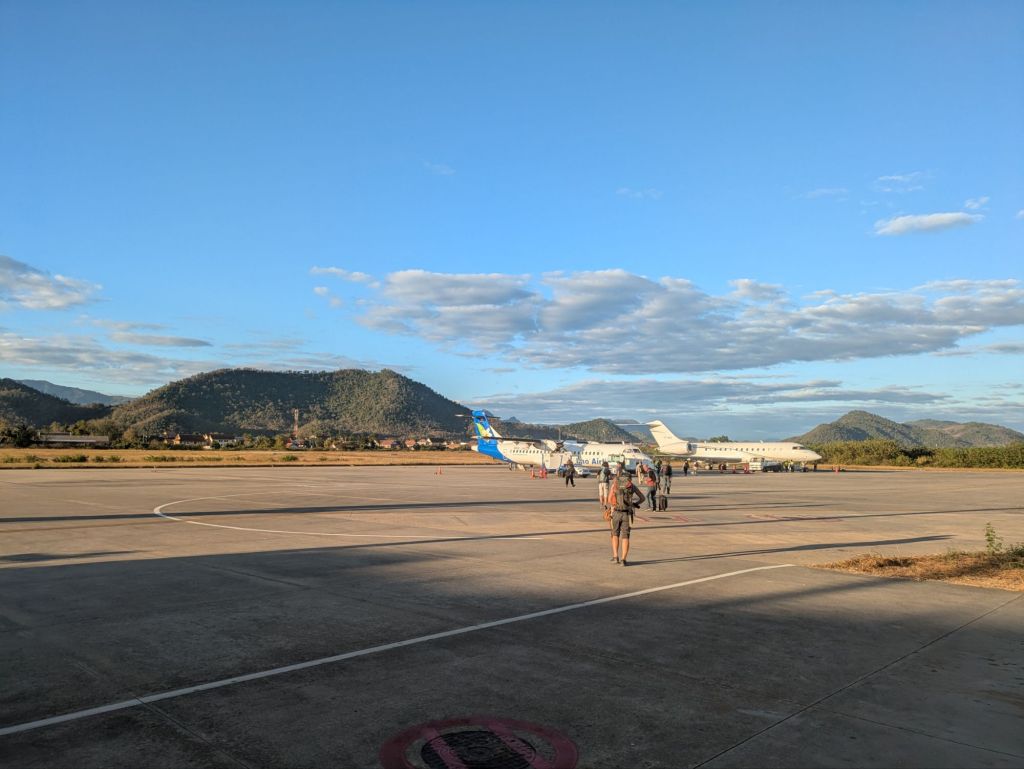
Our last day, our last hour and sadness arrives. We don’t want to leave. The 101st reason to love Laos and Luang Prabang comes to mind – the airport is only 10 minutes drive, and a beautiful 10 minutes at that. It is one building with four flights leaving. We arrive early and drink green tea until we board the little twin-prop plane while hoping for calm skies. Next stop Hanoi in Northern Vietnam.
A humble and sincere ‘khobchai’ all round (thank you).
 Travels with my Family
So now Pepper knows why she is being fattened up..
LikeLike
I’ve been holding my breath for some geology and now you’ve delivered. Fantastic. keep it up. Also slightly confused, are you saying you’ve eaten Pepper?
LikeLike