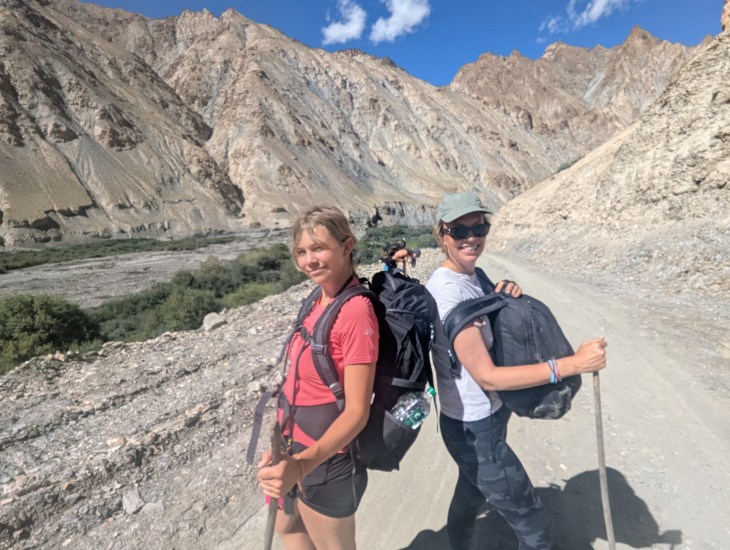
[Edit; this all seems a bit trivial in view of the floods in Nepal. I’m going to leave the post up and thoughts are with those affected]
“Dan, this trek we’re doing in India, it’s not that difficult is it?”
Lucy is asking me a simple but relevant question. We are in the sunless trough of January or February and our hiking in Ladakh in August seems a million miles away.
Good question Luce. I need to believe we can do it. My confidence is based on nothing beyond the fact our planned 6 day, 5 night trek in the Markha Valley is Ladakh’s most popular trek. And surely the ‘most popular’ trek must be doable, or else how could it be the most popular? Plus our local travel agent (based in Leh and recommended to us), who has organised it for us, said it was doable. So, it must be, right?
“Er, I think we’ll be okay.”
Lucy knows better than to trust my close-the-conversation-down glibness and the chat moves on, possibly to Trump invading Iran, possibly to the dilemma of choosing Gail’s or Colombia (good coffee near us in Oxford) on a quiet Sunday morning.
A week before we leave, a friend says “You must have done some training for this trek, haven’t you?” Well, let’s see. Lola’s been running during her exams, Cesca does rowing, Lucy is a hot yoga guru and recent peloton disciple and yours truly bores the crap out of everyone about his running and cycling.
Whether a bit of running and yoga helps you at 4500m is another matter.
The trek: a battle against altitude rather than gravity
There is quite a lot of altitude chat in this post, but the fact that oxygen decreases as altitude increases is the crux when trekking in Ladakh, not the normal upwards heave of mind, body and rucksack against gravity. Most of the UK lives within a few 100m of sea level and our highest point is Ben Nevis at 1300m (all figures are above sea level). The highest point in mainland Europe is Mont Blanc at 4808m. If you’ve been skiing, most Alpine resorts are from 1000m to 2000m with the highest glaciers you can ski at c. 3000m.
Altitude sickness can kick in from 2000-2500m. It starts with headaches and dizziness and, at worst, kills you. The rule of thumb is only ascend 500m per day and to ‘climb high, sleep low’ which means ideally you spend some of the day higher than where you will sleep. Which is easy to say and bloody hard to make happen. The process of acclimatising to altitude takes time and doesn’t care how much fitness or money you have, nor which probiotics or supplements you are taking. If you’re visiting Ladakh from the UK in your two week summer holiday, time is the one thing you lack. Hence the challenge: can we acclimatise sufficiently to do this trek?
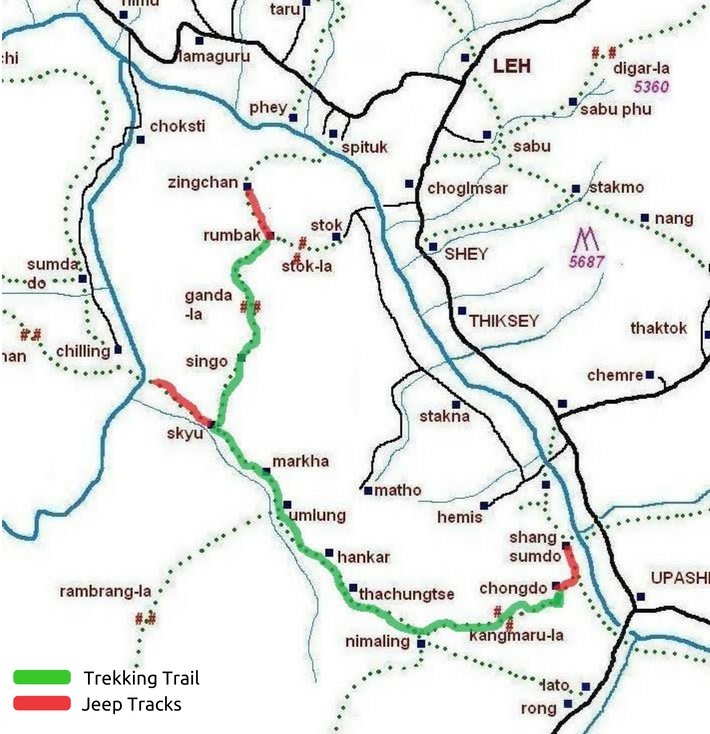
My fake confidence from Jan and Feb aside, I put our chances at 50/50. The Markha Valley trek starts at 3500m and follows the Markha River valley, turning left at Hankar at 4000m then it is two days to go up and over the infamous Kangmaru La pass at 5200m on the fifth day. For those of you following, that is 4km higher than the top of Ben Nevis and 5km higher than Oxford. We had 2 nights acclimatising at 3500m before we started and were out of breath climbing one flights of stairs in the hotel in Leh. One flight. Perhaps that 30 minute peloton session should have been 45 minutes?
So when Lucy asks me if it is going to be difficult, I figure that ignorance is bliss – why worry the family ahead of time?
The trek: our adjectives fall short as we make a solid start
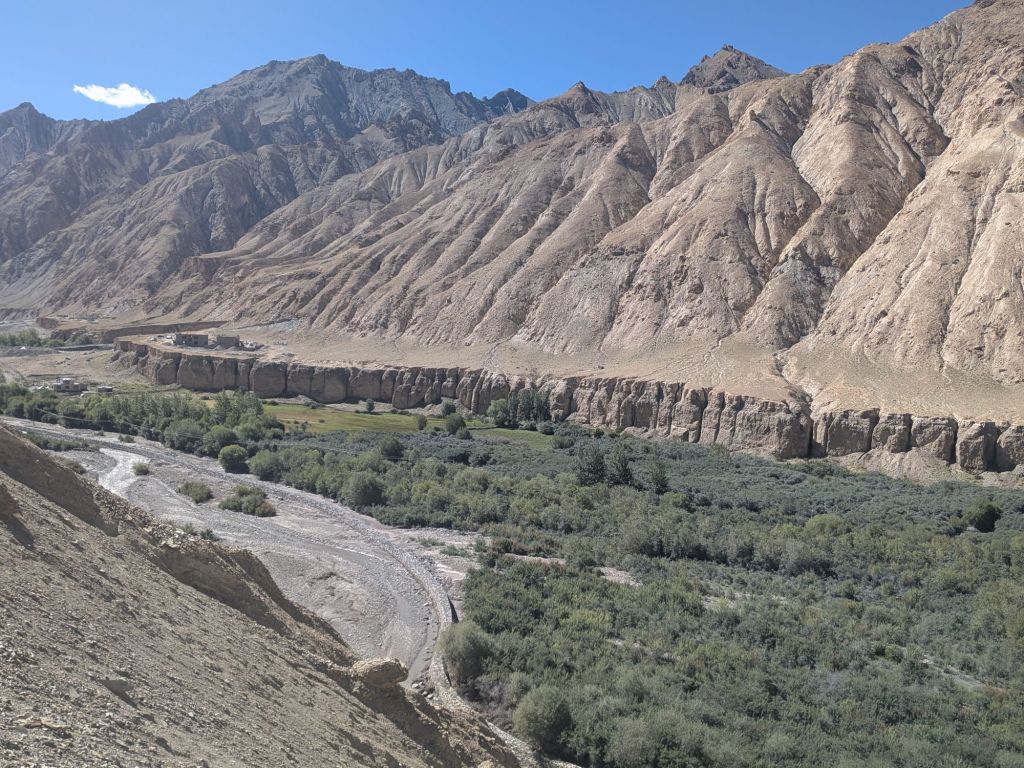
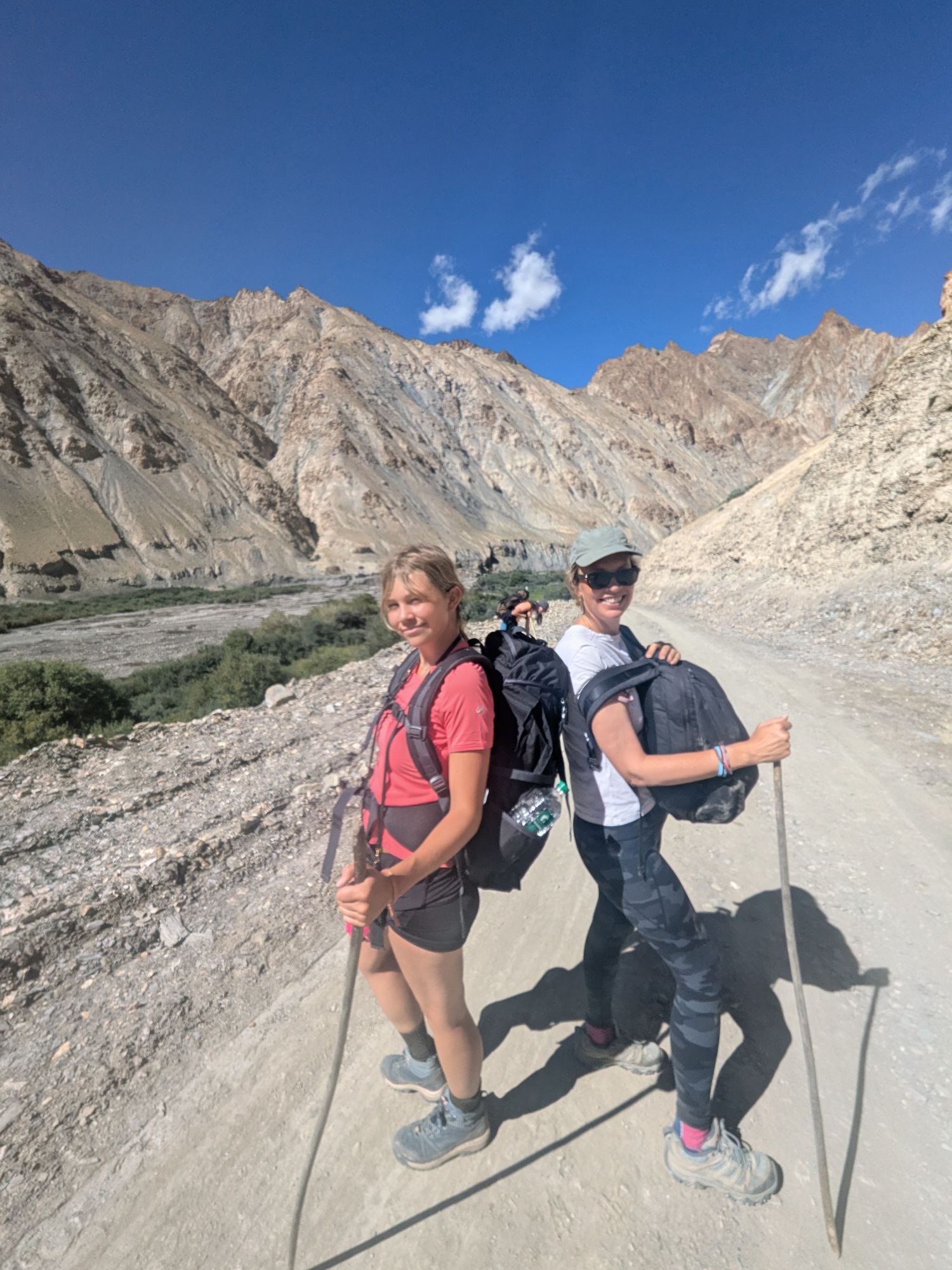
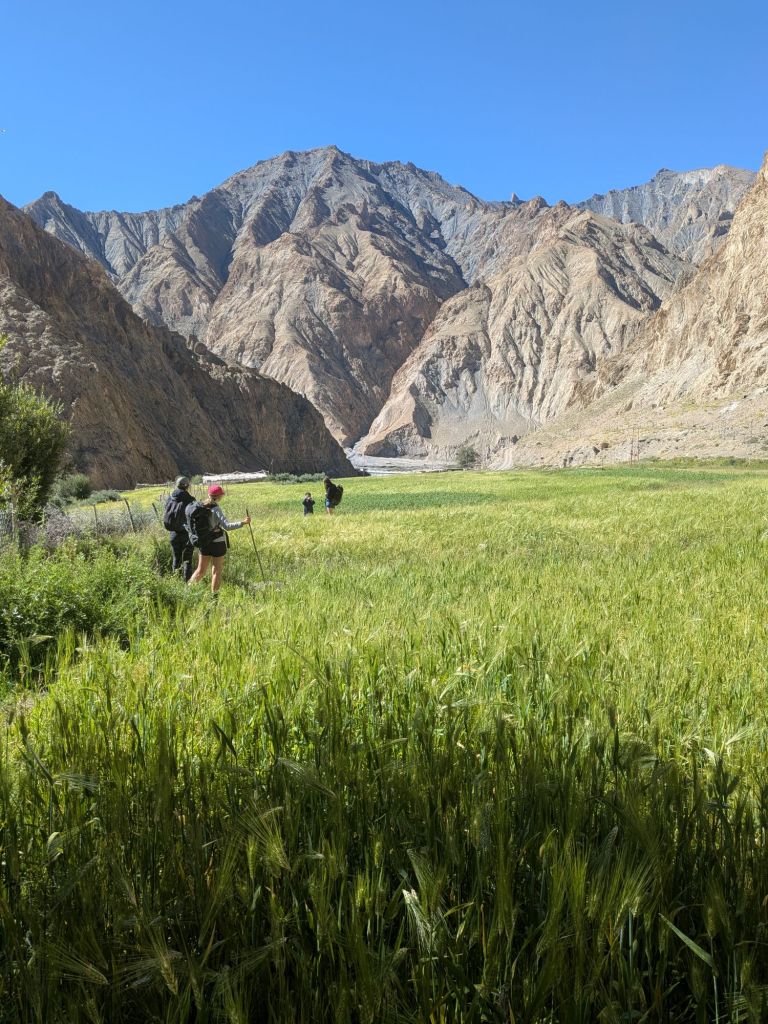
The Markha Valley is between the Stok and Zanskar ranges of the Greater Himalaya. It is dry, barren, angular and treeless except for the intermittent fertile sections where the river valley flattens out. The peaks are only 400-600 metres above us but they feel bigger and we feel tiny as we walk up the dirt road that is the start of the trek.
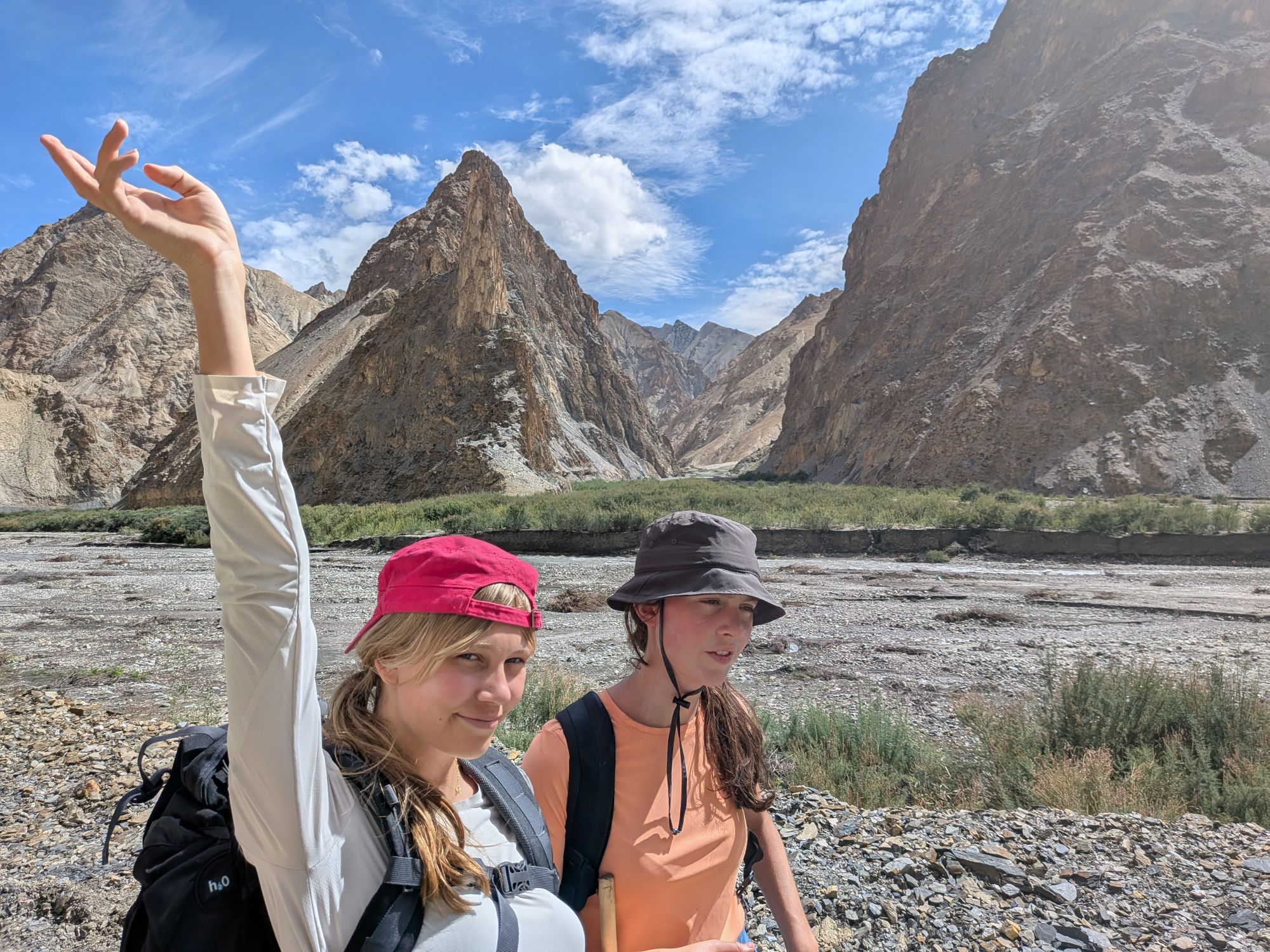
Around each corner is another million-dollar view, or perhaps that should be a ’45 million-year-view’ given that is the age of these mountains. Glaciers and rivers carved this wide, intimidating valley over time and during the many hours of walking we play a game: choose an adjective to describe the environment and the feeling it creates. Our vocabulary fails to nail it: epic, inspiring, humbling, cinematic, amazing (obvs), huge, awesome (in the truest sense of the word), exhilarating, lonely, tough, peaceful, compelling, ancient, monumental, exciting.
In some ways, the towering, sharp peaks which watch us thread our small steps in slow motion and listen to our simple chat can make you feel both claustrophic and agoraphobic. ‘Claustro’ as you cannot escape the might of the rock looming over you; ‘agora’ as this is life on the biggest scale and you will never feel so insignificant. Claustro-agora – a new trend perhaps.
Village life in the valley: farming, the ‘curse’ of cash and traditional WCs
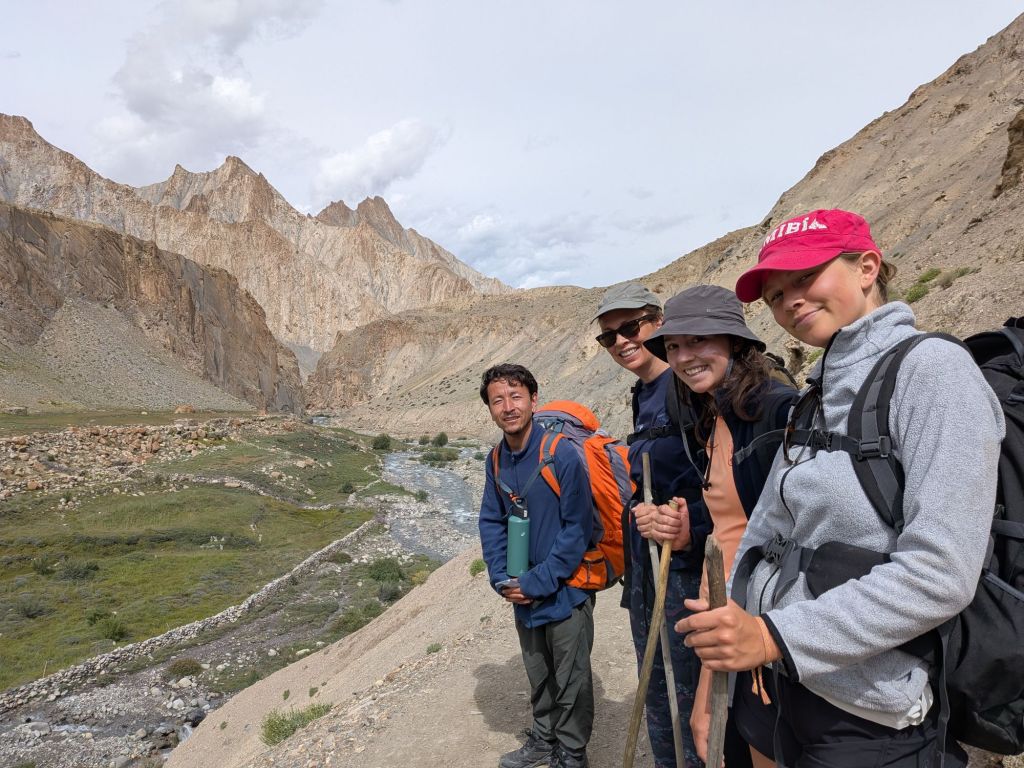
Almost everything we learned during the trek came from Lobsang, our wonderful, smart guide who grew up a few valleys away and speaks five languages to our 1.25 (if you can call our French 0.25). Next to each flat river section there are fields of barley, peas and wheat and a village – a sprinkling of houses where a third seem to be abandoned without windows and rooves, a third are being built and a third are lived in. We stay in ‘Homestays’ where you are given a mattress and about about 10 rugs, a superb dinner of rice, dahl and veg curry, a breakfast of porridge and omlette and a packed lunch for the next day.
This tourist services lives alongside the traditional subsistence farming, where the harvest from the summer has to feed each family through the winter where everything freezes for 3 months with minus 30 Deg C common at night in January. Families survive by heating only one room (burning firewood and cow dung) and that is that last time I will complain about my bedroom being 29 Deg C during a heatwave in the UK. The houses have no insulation and no heating.
The introduction of the cash economy is inevitable and must be a far easier way for our hosts to survive than farming barley on almost-flat tiny fields. That said, one of the trekking guides we meet grew up in this valley and he says “Of course when you introduce money then all the problems start. Maybe it was easier before the tourists came.”
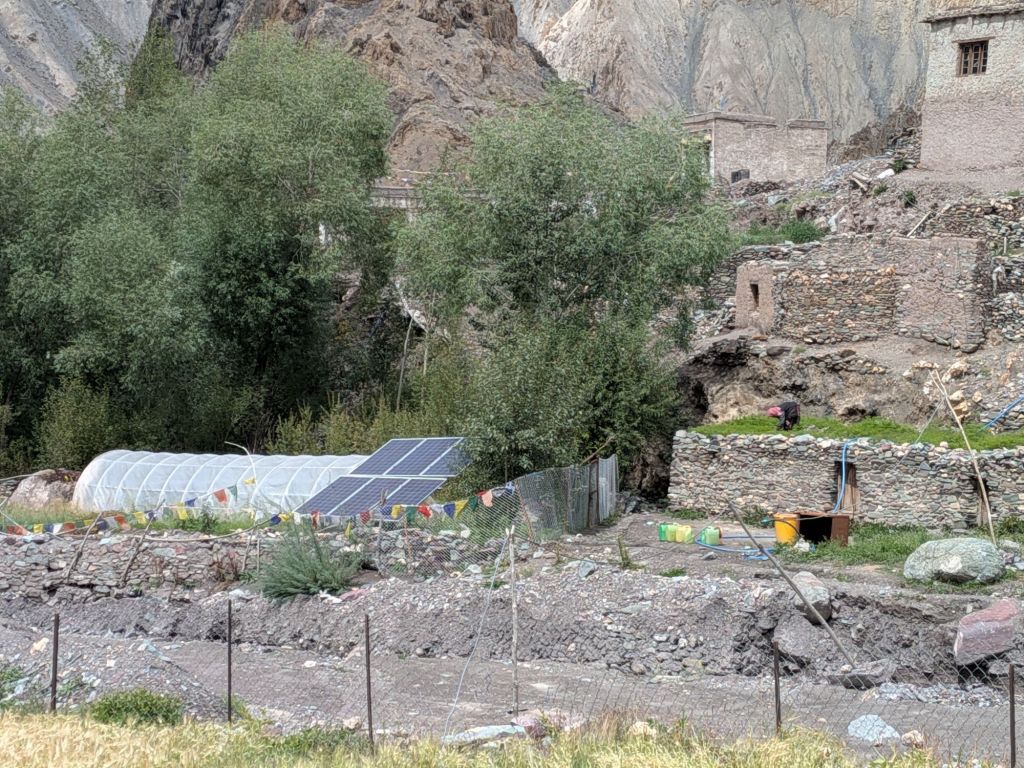
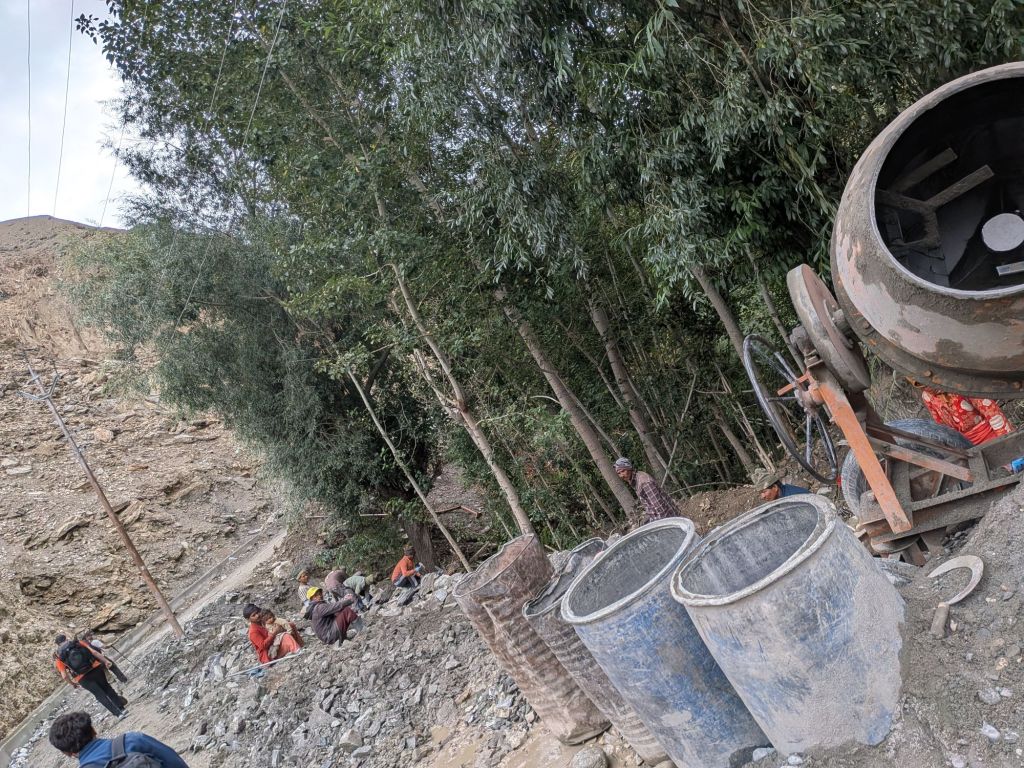
The infrastructure is better that you might think. Since Ladakh became separated from Kashmir in 2019, apparently the Government has invested in electricity, roads and schools for the villages. Most houses have a small amount of solar power, there are phone masts throughout the valley and there are squads of workers repairing walls which looks back-breaking. The stonemasons are all men while the women (scarves covering face and nose) do the heavy worm of pickimh up the larger rocks which have been smashed out of the nearby cliffs.
There is one area which has yet to be brought up to Western standards, not that our standards must be the target to aim for. Sanitation. Drinking water is easy for the villagers: they drink the mountain water. Personal washing is done via (heated if you are lucky) water from a bucket in a small windowless ‘bathroom’. As for the sewage system, if you are squeamish then the WCs will be a challenge: tiny rooms with no light and a hole in the floor where you can see the evidence of the previous 500 visitors. There is a pile of horse manure in the corner and a shovel, which creates the most unforgettable smell: human meets horse. The dung is added to human waste to absorb moisture, limit odour and flies and aid decomposition so that the mixture can be used as fertiliser.
A typical day and the pee-or-dehydrate decision
You don’t need a blow-by-blow, or step-by-step account. A summary will do. We meet a Norwegian lady and her guide and we spend two days with them on-and-off. She runs a Nepal trekking business and with her expertise and two Ladakhi guides we are in the safest, most experienced hands possible.
The walking is fun. Generally. Breakfast at 8am, leave at approx 9:15 and walk until 3pm or 4pm after stopping for lunch and ginger tea where we can (brewed by entrepreneurial women, some of them funded by NGO’s to help create more independence for the Markha valley villagers). We go slowly, sometimes chatting, often in silence, sometimes with music (from our limited spotify downloads), sometimes playing games (The Minister’s cat is _____), normally strung out (distance-wise, not emotionally) and always in no particular hurry. Clouds are our friend – when the sun emerges, the perceived exertion doubles. Rain only visits once and we’re waterproofed up in a jiffy. There are few fellow trekkers, or at least few at our pace.
What do you do from 4pm until bedtime? Not much beyond contemplate how deeply your phone addiction has infected your bones. We read, play cards, chat, drink more ginger tea, stare at the views, listen to pre-downloaded podcasts, try to wash and if there is no lukewarm water available then it’s a wet-wipe-shower. The involuntary digital detox was an attraction of the trek yet is hard to manage. The quality of the evening meals is beyond belief – some of the best vegetable curry we have ever eaten, even allowing for increased hunger after the 20,000 steps per day average.
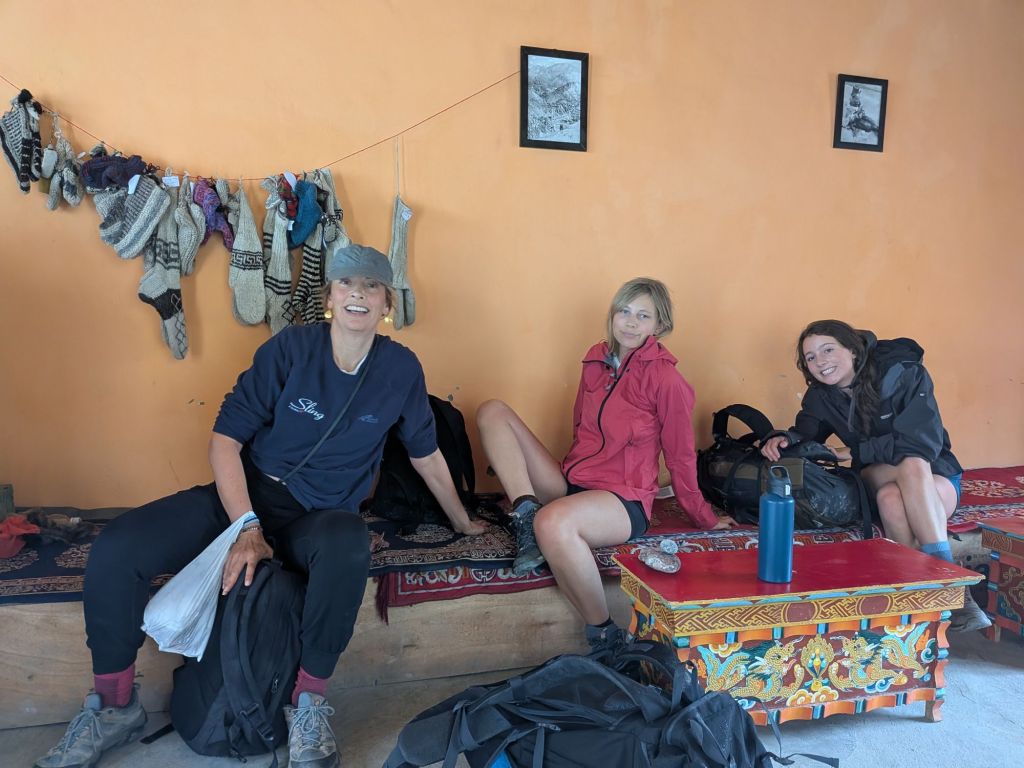
As stated above, the WCs are outside, pitch black at night and not the most inviting environment. Therefore from 4pm onwards you have a choice: drink enough to avoid dehydration and accept that you will need a midnight trip to the loo; or reduce liquid intake to avoid any external nocturnal adventures and accept the next morning’s hangover-esque dehydration. I choose the former, Cesca chooses the latter, Luce and Lola try and avoid both.
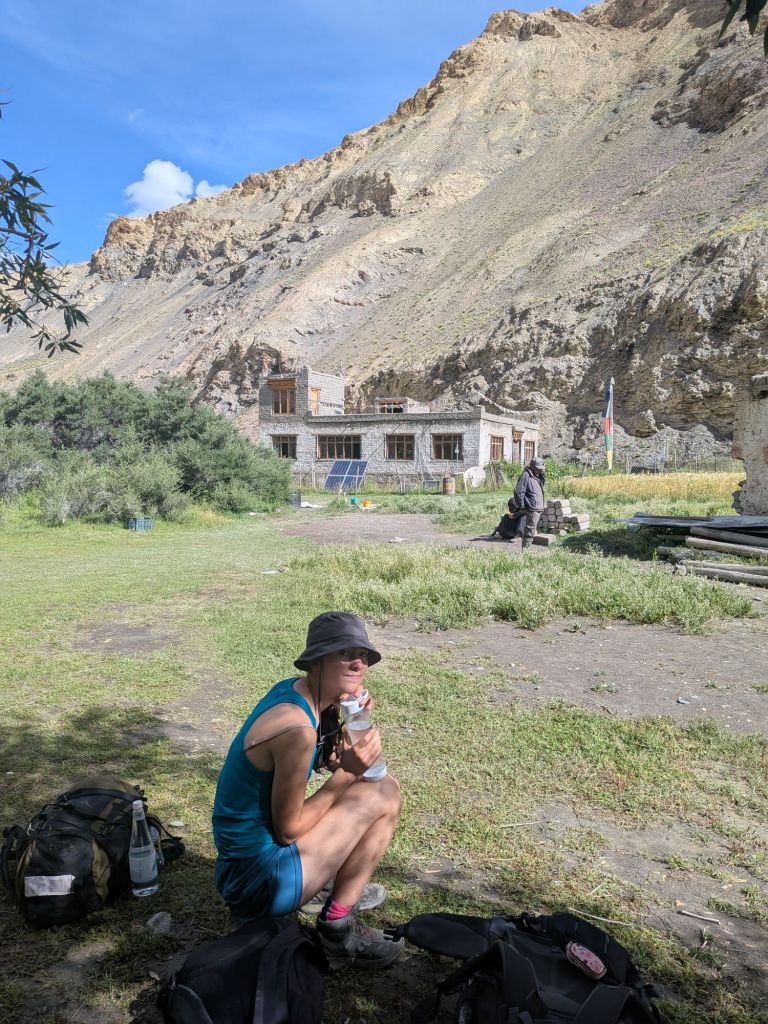
End of Day 3 – 4200m and finally ‘climbing high sleeping low’
At the end of Day 3 we are in a ‘Tent Stay’ at 4200m and it is probably the most beautiful place I have ever camped. We are now in the Nimling valley and where it opens up a few level terraces have been carved out for the trekkers. The other groups at this site have their own tents and cook, all carried up by horses. We see a few ‘horse trek’ groups and feel mixed about it – it gives the trekkers freedom and it disperses more cash into the economy, but the horses’ skill at climbing steep rocky paths is only matched by how miserable and thin they look – at the end of the day they are tied up into a line, unable to move and unwilling to lie down. Yes, this is superimposing UK welfare standards onto an ancient tradition and perhaps the horses love it. Even so, the ethics looks dubious at best.
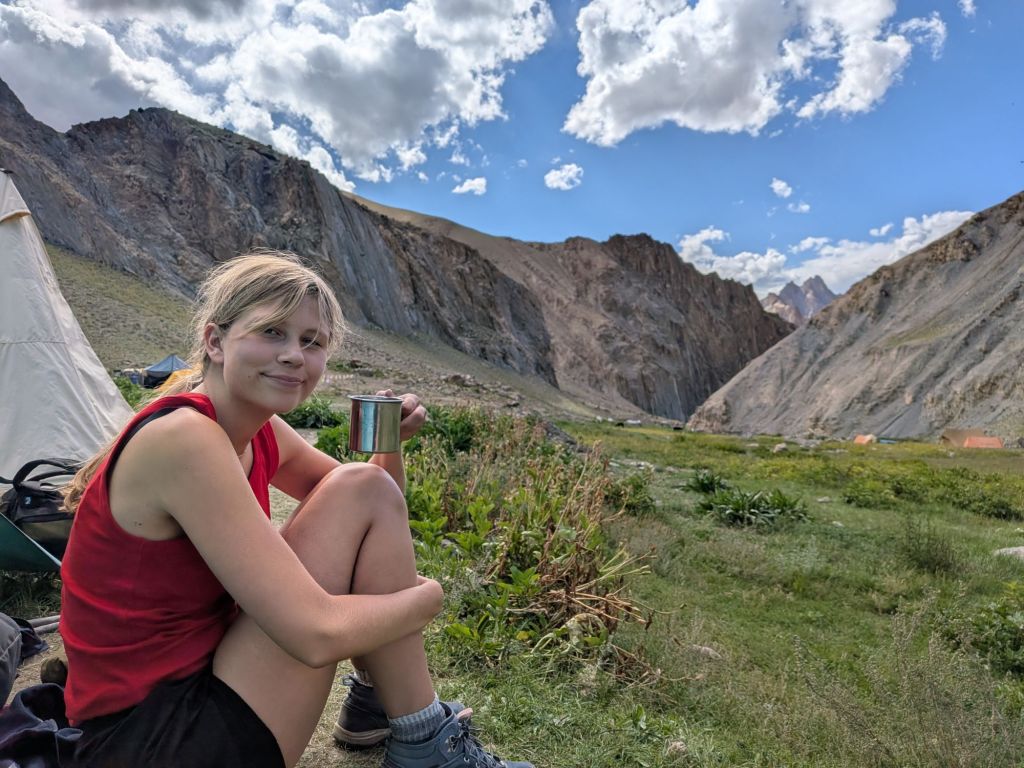
After more tea at our Tent Stay, Lobsang forces us to go on another hike – so we can ‘climb high’ to force a bit more altitude into the blood before returning to 4200m. This ‘bonus’ hike almost kills Luce as we reach 4350m with half of the Greater Ladakh Himalaya seemingly at our level. We sit for an hour, gently chatting about Ladakhi eco gurus and football as the golden hour sunlight fades. Luce makes it down, just about.
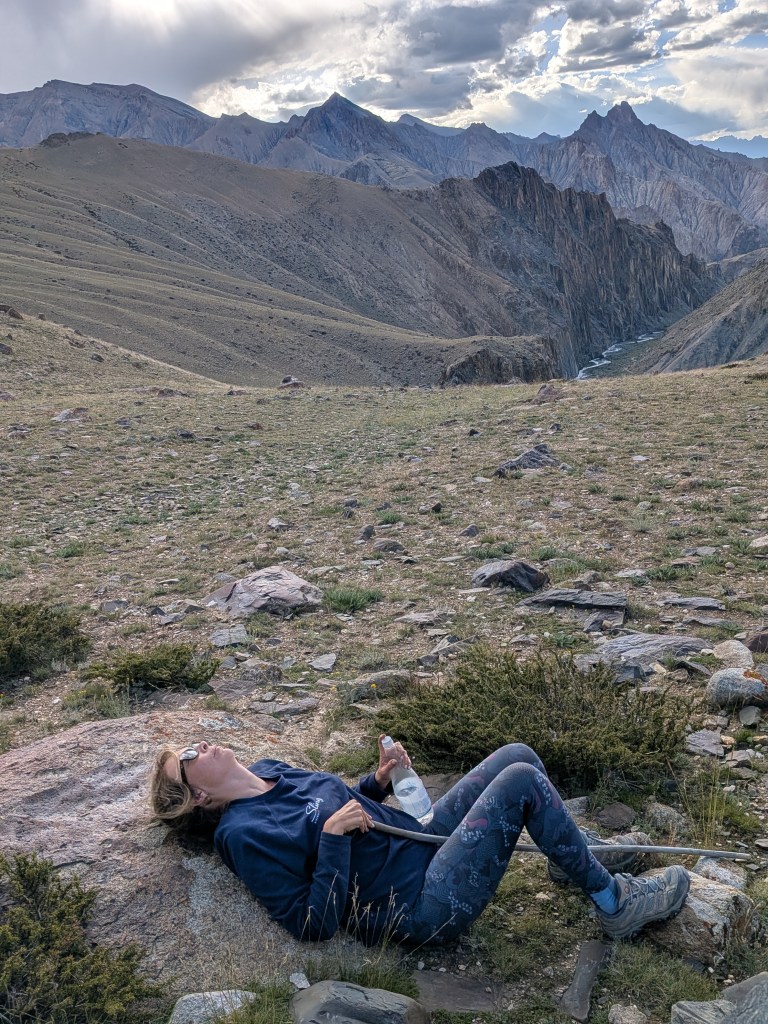
Day 4 should take us to Nimling campsite at 4800m. Then on Day 5 you make the final push to 5200m before descending to 3900m. As we go to bed on Day 3, we have headaches and a bit of dizziness. It is bewildering how 200 or 300 metres can make such a difference – we felt fine at 3900m. We try to brush it off as we spend the night under canvas for the first time. Positive vibes for a big Day 4…
The Buddhist influence casts its own spell
Can you imagine trekking across the Peak District or Snowdonia, only to come across stones etched with ancient Christian prayers, all offered as symbols of love and devotion to Christ / God? Can you picture large Christian statues or mini churches dotted across the Cotswolds or Cairngorns? I can’t.
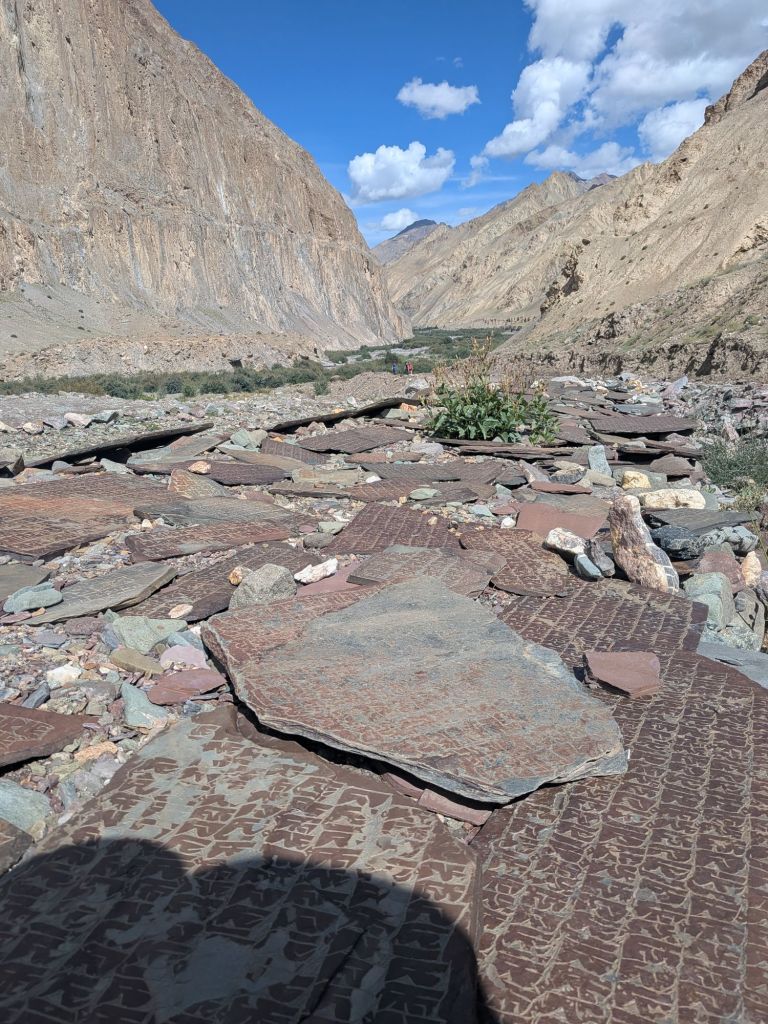
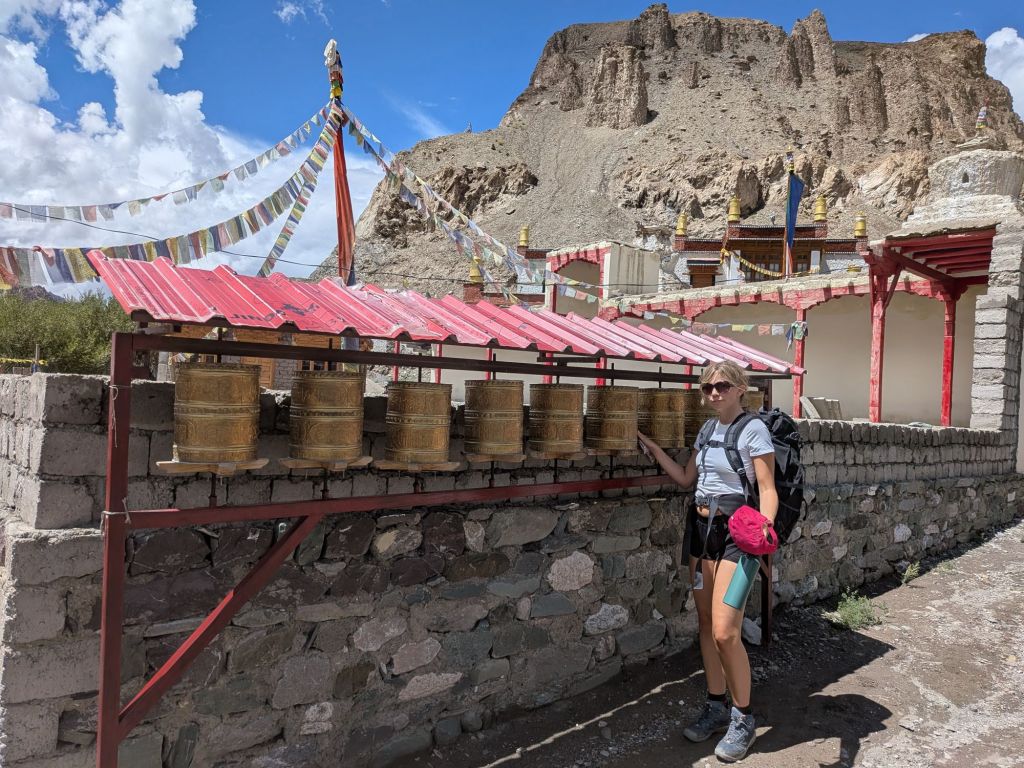
Perhaps this is ignorance, and you may know of ancient Christian stones or treasuers across the UK, but I have seen nothing as visible as the trail of Buddhist culture across the valley. Even for the stoney-hearted (pun intended), there is something alluring about how the beliefs of the people are still relevant today. Coloured prayer flags cover many bridges, walls and houses and Lobsang our guide makes sure that we pass every small stupa on the left (or clockwise side). As we’ll see in a forthcoming post, we have a more intense collision with Buddhism ahead. For now, the trek only seems more uplifting for the religion’s influence.
Heartbreak on Day 4 as that 50/50 prediction lands sunny-side down
Failure sucks.
Let’s not get into a LinkedIn-bullshit-post about failure being the greatest teacher. While it may be, it is still inescapably shit.
As stated above, we go to bed (tent) on Day 3 feeling a bit shaky, a bit altitude-y but believing we can carry on the next day.
But.
We start Day 4 with stomach problems and altitude sickness: headaches that persist and dizziness. We know that ascending 500m will make the altitude symptoms worse and we know that there is no escape route from the Nimling camp above beyond coming back down to 4200m. Given that we have limited time, given that our guide has a duty to keep us healthy, given that we cannot in all good faith ask those who are ill to climb higher which will make them feel worse…..we are forced to turnaround.
That’s the thing about 50/50 calls – there is a good chance they go wrong. Maybe even a 50% chance.
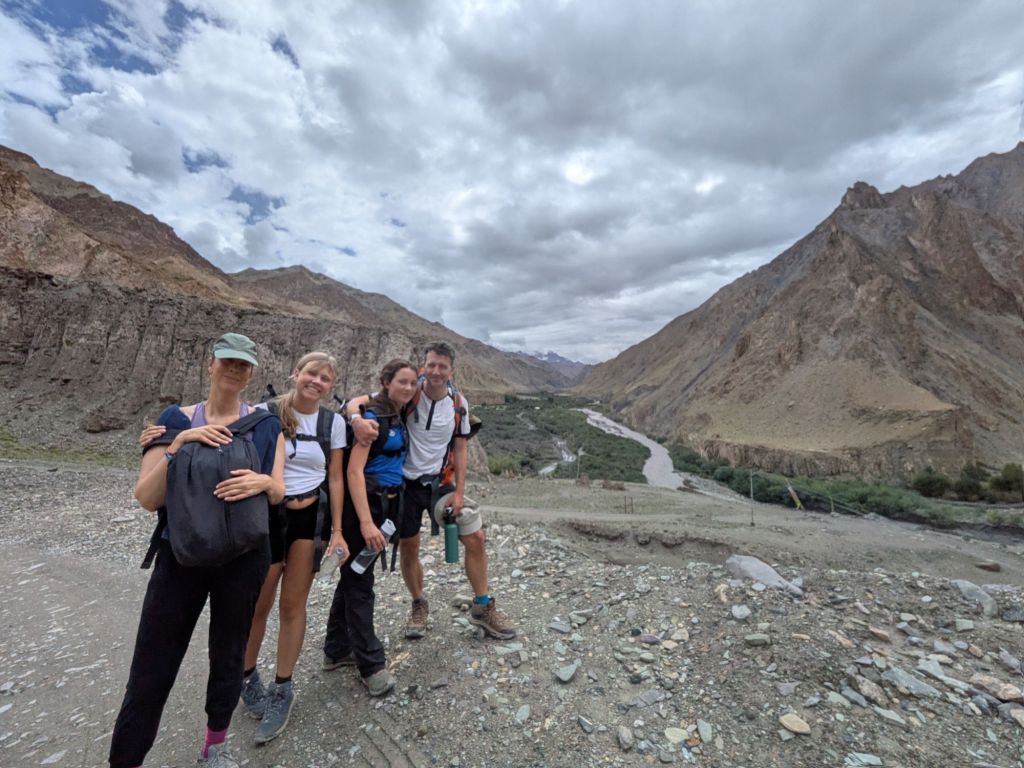
While we know how lucky we are to come this far, it is still a heavy call and, as you would expect, a sombre day. We open up at dinner and talk about how we all feel like failures. My view is that we have to accept that feeling before rushing into learnings and next steps. The feelings are natural, and it is only the next day when we awake to the bluest cornflower sky of our brief lives, and a view that breaks and mends hearts, that gratitude floods back in and we feel elated at having been to a place that is so special.
To conclude…
Five of the best days of our lives.
One of the most spectacular valleys and mountain ranges on earth.
The kindest people you could hope to encounter.
Our guide, Lobsang, is one of the wisest and most thoughtful people we have met.
You need more than hot yoga, peloton and cycling-lycra. You need time – time to acclimatise.
Altitude takes no shit from anyone.
And yes, fragments of unfinished business remain – failure even – as the high of hitting 5200m eludes us.
Maybe another time…


love this!!!
LikeLike
Well done team Channer!
LikeLike